Branded vs. Generic Queries: The 45.7% Blind Spot in Agency Reports
Branded vs. Generic Queries: The 45.7% Blind Spot in Agency Reports

Branded queries contain a brand, product, or domain name and signal existing awareness, while non-branded queries don’t and represent the main channel for new-customer discovery. Ahrefs found that branded searches make up 45.7% of total Google search volume, which means client reporting that ignores this split is missing nearly half the picture.
TL;DR:
- Branded terms account for 36.9% of unique keywords, concentrating demand in fewer searches and making brand defense easier to monitor alongside discovery.
- Search Console’s branded filter includes 16 months of history, but can misclassify queries and excludes properties with few impressions; validate results with a custom regex.
- Fix mismatched intent pages before creating branded content; newer clients should focus budgets on nonbranded discovery, while established brands should review branded gaps quarterly.
- Use branded PPC when competitors bid or search features push organic results below the fold; otherwise, test briefly and stop if results show no lift.
- For local clients, rank tracking across geographic grids reveals neighborhood map pack gaps that site wide Search Console data cannot show.
Table of Contents
- What branded vs non-branded queries are and why the split matters for client strategy
- How to measure and segment branded vs non-branded queries for clients
- Prioritization framework: which branded and non-branded opportunities to act on first
- PPC and SEO overlap: when to bid on branded terms and when to avoid it
- Operationalizing the split: reporting, KPIs, and workflows you should deliver to clients
- Agency-first perspective: recommended allocation across brand defense and discovery by client stage
- Maprank: a practical tool for agencies to track local branded visibility and deliver white-label reports
- FAQ
- Sources
What branded vs non-branded queries are and why the split matters for client strategy
A branded query includes a brand name, product name, domain, or a close variant, like a common misspelling or a shortened product title. “Maprank pricing,” “nike running shoes,” and “mailchimp login” all count as branded. A non-branded query describes a need without naming a company: “local seo rank tracker” or “best running shoes for flat feet.” The line gets blurry with product-line names that sound generic but belong to one company, so agencies need a documented rule for edge cases rather than a case-by-case guess.
The split matters because it reflects two different jobs. Ahrefs’ 2025 study found branded searches represent 45.7% of total search volume while only 36.9% of unique keywords are branded, meaning branded terms carry disproportionate volume per keyword. That skew shows branded demand concentrates around a smaller set of terms, which makes it efficient to monitor and defend. Non-branded queries, spread across a much wider keyword set, are where new customers find a business for the first time.

For forecasting, this means branded growth tracks brand equity and marketing spend, while non-branded growth tracks content and authority building. Treating both as one undifferentiated “organic traffic” number hides which lever actually moved the needle.
How to measure and segment branded vs non-branded queries for clients
Start inside Google Search Console’s performance report, which added a branded and non-branded query filter with 16 months of history. The filter is useful but imperfect: Search Console itself notes classification can be inconsistent, and the feature isn’t available for low-impression properties.
A reliable agency process looks like this:
- Export the full query list from Search Console, then apply the branded/non-branded filter as a first pass.
- Build a custom regex filter using the client’s brand name, common misspellings, and product names to catch anything the default filter missed.
- Cross-check low-impression or newly launched domains manually, since the native filter may not surface data for them yet.
- Split the export into two lists: branded queries you already rank well for, and branded queries where rankings lag or don’t exist.
For each segment, capture the same core metrics so comparisons stay apples to apples:
- Impressions and clicks, to size the opportunity.
- Click-through rate, which often reveals SERP feature interference.
- Average position, to flag branded terms slipping below the first result.
- Conversions or a proxy goal, since branded intent typically converts at a different rate than non-branded.
Prioritization framework: which branded and non-branded opportunities to act on first
Not every gap deserves the same attention; agencies can follow practical internal linking guidance to optimize branded pages effectively, as outlined in Internal Linking for Clinic SEO: A Practical Guide. Sort opportunities into three buckets: underperforming branded keywords (terms the client should own but doesn’t), mismatched-intent pages (a branded query landing on a page built for research instead of conversion), and valuable new branded queries emerging from recent campaigns or press mentions.
Rank each bucket against a simple triage matrix: potential impact, measured as search volume multiplied by conversion intent, against the effort required to fix it.
- Quick wins: a product page outranked by a review site for its own branded term, or a high-volume branded query sitting at position two or three instead of one.
- Medium effort: rebuilding a landing page to match branded search intent when the current page targets a broader topic.
- Longer plays: building non-branded authority content when a client has low existing brand recognition and most of the addressable demand is still non-branded.
Pro Tip: Fix a mismatched-intent page before writing any new branded content, since new pages inherit the same intent problem if the underlying page structure is wrong.
Clients with strong brand recognition deserve branded-defense work first. Newer or smaller clients usually get more return from non-branded discovery content, since there isn’t much branded search volume yet to defend.
PPC and SEO overlap: when to bid on branded terms and when to avoid it
A large-sample study of PPC and SEO overlap found that brands frequently bid on their own branded keywords even when they already hold the top organic spot, creating redundant spend in many cases. That doesn’t mean branded PPC is never worth it, but it does mean the default shouldn’t be “always bid.”
Use a short set of decision rules instead of a blanket policy:
- Bid on branded terms when competitors are actively bidding on the same name, since losing that auction can cost a client the top of the page.
- Bid when SERP features (maps packs, shopping carousels, People Also Ask) push the organic listing below the fold even at position one.
- Skip branded PPC when the client’s organic result already dominates the page and no competitor is bidding against the name.
- Run short PPC tests to try new messaging or react to a volatile SERP layout, then pull budget once incrementality data shows no real lift.
Document every decision in the client report: what triggered the bid, what it cost, and what organic already delivered for free. That transparency is what keeps PPC and SEO budgets from fighting each other.
Operationalizing the split: reporting, KPIs, and workflows you should deliver to clients
A client report built around branded vs non-branded should include the volume split and its trend over time, conversions by segment, a short list of underperforming branded keywords, and clear next actions for each one. A large share of search volume comes from branded searches, per Ahrefs, meaning a client’s non-branded growth plan only addresses part of total demand, which is worth stating plainly in any strategy review.
Cadence matters as much as content. Monthly monitoring catches drift early, quarterly reviews reset strategy and budget, and ad-hoc audits cover product launches or reputation events that spike branded search overnight.
A repeatable workflow keeps this from becoming a one-off project:
- Discovery: pull and categorize current branded and non-branded performance.
- Audit: flag mismatched-intent pages and underperforming branded terms.
- Action: update landing pages, build missing content, or adjust bids.
- Measurement: re-check the same metrics after a defined window.
- Report: package findings into a white-label client report.
Local and multi-location clients add a layer that keyword data alone can’t show: neighborhood-by-neighborhood visibility. A grid-based rank tracker can surface a branded query ranking first downtown but dropping out of the map pack three blocks away, a gap that site-level Search Console data never reveals.
Agency-first perspective: recommended allocation across brand defense and discovery by client stage
Most agencies default to one playbook regardless of client maturity, and that’s the wrong call. New clients with little brand recognition should get a quick branded audit (an afternoon of work, not a project) to grab any easy wins, then the bulk of the budget goes to non-branded discovery content, since that’s where almost all of their addressable demand sits.
Established clients flip that ratio. Once brand recognition is real, protecting and optimizing branded SERPs returns more per hour than chasing another long-tail topic. Review the branded list quarterly at minimum, and immediately after any press mention, product launch, or review-site spike.
One rule holds across both stages: fix a mismatched-intent page before building new branded content on top of it. A new page inherits the same structural problem and wastes the effort twice.
— Local
Maprank: a practical tool for agencies to track local branded visibility and deliver white-label reports
Keyword-level data tells us whether branded search is growing. It doesn’t tell us whether that visibility holds up at the street level, which is where local clients actually compete. Maprank runs grid-based rank tracking across a client’s service area, so we can show an agency exactly which neighborhoods still show a competitor in the map pack for a client’s own branded terms, not just a single city-wide average.
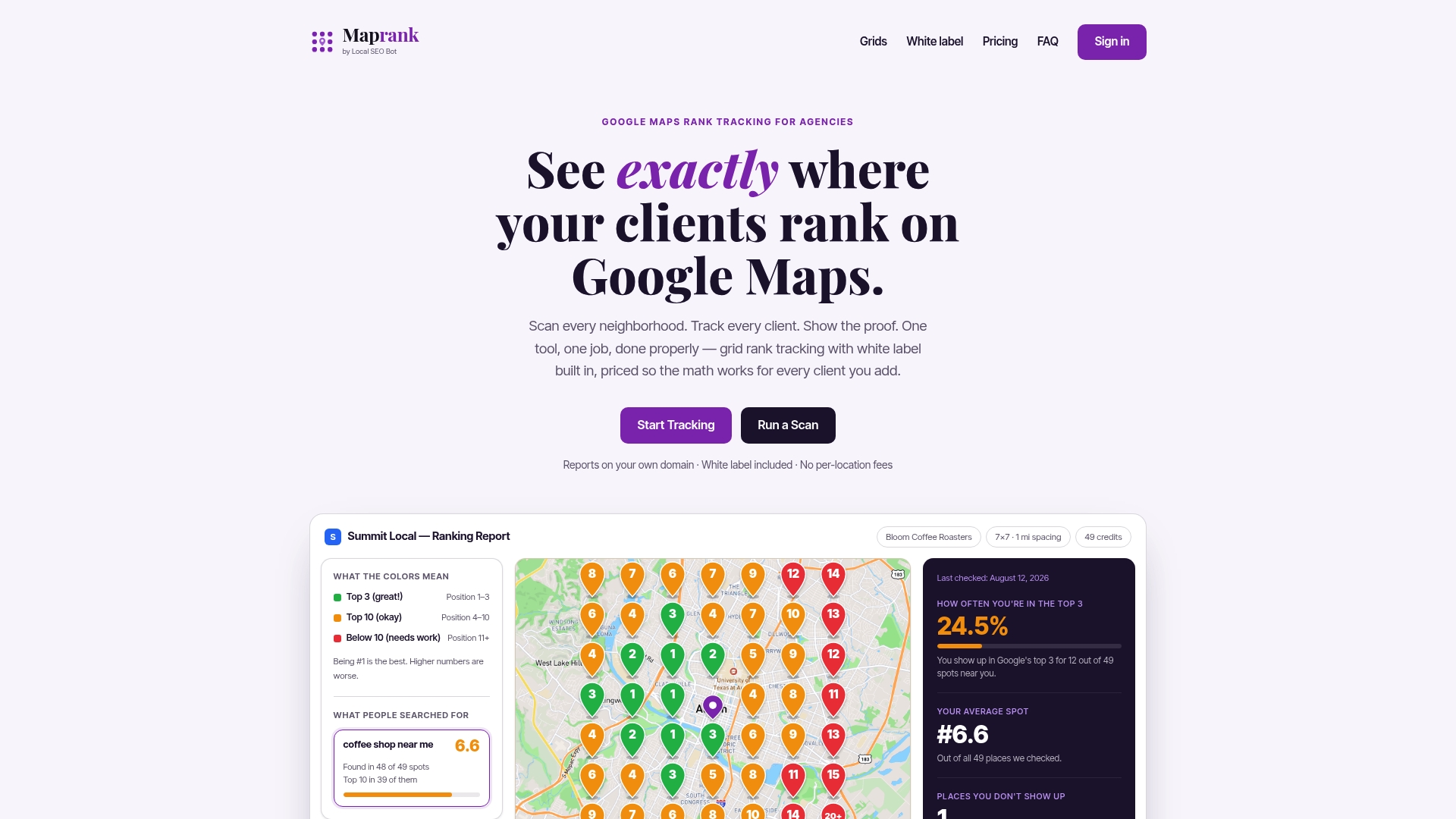
Every plan includes white-label reporting on the agency’s own domain and supports multiple businesses, so there’s no per-location fee stacking up as a client roster grows. That matters for agencies running the branded vs non-branded workflow above across dozens of accounts at once.
- Customizable scan grids show branded ranking gaps block by block, not just city-wide.
- White-label reports carry the agency’s own branding, never ours.
- Unlimited businesses on every plan keep reporting costs predictable as the client list grows.
Our Maprank Solo plan starts at $19 per month for agencies testing the workflow on a single client, with an Agency, Pro, and Scale plan available as the roster grows. For a single quick check before committing, our one-off rank check is available for agencies who want to see grid data on one client first.
FAQ
What counts as a branded query versus a non-branded one?
A branded query contains a brand, product, or domain name, including common misspellings, while a non-branded query describes a need without naming a company. Agencies typically maintain a running list of brand variants to catch edge cases that automated filters miss.
How much of total search volume is branded?
Ahrefs’ 2025 study found branded searches account for 45.7% of total Google search volume, even though only 36.9% of unique keywords are branded. That gap shows branded terms carry outsized volume relative to how many distinct keywords exist.
Can I trust Google Search Console’s branded/non-branded filter?
The filter is a useful starting point but Search Console’s own documentation notes it can mislabel queries and isn’t available for every property. Pair it with a custom regex filter built from the client’s brand name and known variants for accuracy.
Should an agency recommend paid ads on a client’s own branded terms?
Bid on branded terms mainly when a competitor is actively bidding on that name or when SERP features push the organic result below the fold. Research on PPC and SEO overlap shows brands often bid on terms they already dominate organically, which can mean redundant spend.
How does Maprank help with branded query reporting for local clients?
Maprank’s grid-based rank tracking shows where a client’s branded visibility holds up or drops off across a service area, down to the neighborhood level, which site-wide Search Console data can’t show. Reports are delivered white-label on the agency’s own domain across all plans.
Sources
- Almost Half of Google Searches Are Branded. Here’s Why That Matters
- Performance report (Search results): Dimensions and data groupings - Search Console Help
Recommended
- Rebrandable Rank Tracker for Agencies: Make It Look Like Your Own Product
- White Label SEO Rank Tracker: Build Client Trust With Branded Reporting
- White Label Local SEO Reporting Tool: Deliver Professional Reports Under Your Brand
- White Label SEO Reports: How to Deliver Professional Client Reports That Win Renewals