Citations for Map Rankings: What They Do and How to Fix Them
Citations for Map Rankings: What They Do and How to Fix Them

Citations help your Google Maps ranking mainly by keeping your business information accurate and consistent across the web. They are not a switch that pushes you into the top three. Clean, matching listings make it easier for Google to verify who you are, and they keep customers from landing on wrong phone numbers or old addresses. Below, we cover what counts as a citation, which details have to match, how to audit a messy footprint, and what to do when your map position drops.
TL;DR
- A citation is any online mention of your business name, and usually your address and phone number, on a third-party site. Directory listings are structured citations. Mentions in news, blogs and social posts are unstructured.
- Accuracy beats volume. Hundreds of copied listings do less than a few dozen correct ones on sites people actually use.
- Audit before you build: find duplicates, old addresses and mismatched phone numbers, then fix those first.
- When a map ranking drops, check by query, location and device before you touch anything. A drop in one neighborhood is a different problem from a drop everywhere.
- You can only judge whether citation work paid off by measuring map position block by block, not by checking one search from your office.
Table of Contents
- What a citation is, and what kinds exist
- How Google uses outside information about your business
- Does the number of citations matter?
- What every citation should say
- How to audit inconsistent and duplicate listings
- Where citations sit among the other things that move rankings
- Why a map ranking drops, and how to investigate
- A perspective from the people who watch the grids
- Track the effect of your citation work with Maprank
- Citation priorities by business type
- Red flags in citation offers
- FAQ
- Sources
What a citation is, and what kinds exist
A local citation is an online reference to a business’s name, address, phone number or related details on a third-party platform, according to Search Engine Land’s guide to structured and unstructured citations. The same guide notes that a citation can be as thin as a business name alone, or can carry the address, phone number and other contact details too.
There are two families:
- Structured citations are formal directory listings: a profile with fields for name, address, phone, category and hours.
- Unstructured citations are mentions in places such as news sites, blogs, social media, videos, podcasts, press releases and forums.
Shopify’s guide to local citations lists the usual places a business shows up: general directories, social platforms, industry directories, local blogs and news sites, chambers of commerce, mapping services and data aggregators. For a plumber, that might mean a national directory, a trade association page, the local chamber and a feature in the town paper. For a dentist, add the insurer’s provider directory and the dental society’s member list.
The point of the split is practical. Structured listings are the ones you control and can audit in a spreadsheet. Unstructured mentions are the ones you earn, and they tend to show up when you do something worth writing about: sponsor a team, speak at an event, get quoted. If you want to build more of them on purpose, earned media and podcast placements are one route worth knowing about.
How Google uses outside information about your business
Google does not build your listing only from what you type into your profile. Its Business Profile help says profile information is compiled from public web content, licensed third-party data, user contributions, information from the business owner, and Google’s own interactions with a place or business (Google Business Profile Help).
That is the real reason citations matter. When the web disagrees about your phone number or suite, Google has conflicting inputs, and the version a customer sees may not be the one you intended. Google’s Local Listings Help adds that this information can appear not only in Search and Maps but also on third-party sites that use Google widgets or Google Maps Platform (Local Listings Help). A wrong detail can travel.
Notice what Google does not publish: a formula that says “X citations equals Y positions.” Anyone who sells you a guaranteed bump from a citation package is claiming more than the documentation supports.
Does the number of citations matter?
Less than it once did, and less than sellers of bulk packages suggest. Search Engine Land’s 2025 guidance separates two things: structured listings stay important for discoverability and customer trust, even though their direct influence on the ranking algorithm may be weaker than people historically assumed (Search Engine Land).
Read that carefully. It does not say citations are useless. It says their job has shifted toward being found, trusted and verified. A customer who checks a directory before calling you is helped by a correct listing whether or not it moves your rank.
The cheap bulk offers you see in search results, thousands of submissions for a flat fee, miss this. Ninety thousand low-quality listings on sites nobody visits create a cleanup job for later: every one of them has to be corrected the day you move or change your number. We would rather see you hold 30 accurate listings on sites your customers use than 3,000 you cannot keep current.
What every citation should say
Consistency starts with a single source of truth. Google’s guidelines for representing your business call for:
- the real-world business name, as customers know it
- an accurate address or service area
- the fewest categories needed to describe the core business
- accurate contact information and customer-facing hours
- normally one profile per business
Those points come from Google’s guidelines for representing your business. The same page says that a business displaying an address should keep permanent fixed signage showing the business name at that address. This matters for citations because a listing that shows a street address for a business that does not operate there is both a citation problem and a profile-eligibility problem.
Before you submit anywhere, write down the canonical version in one document:
- Exact business name, with punctuation and “LLC” or not, as it appears on signage
- Street address in one format (“Suite 4” or “#4”, not both)
- One primary phone number, ideally a local number rather than a call-tracking number on every site
- Website URL, with or without “www” and with HTTPS, chosen once
- Primary category and the few secondary ones that honestly apply
- Hours, including holiday hours
Tracking numbers are the classic trap. If you use a different call-tracking number on each directory, you have created the inconsistency you were trying to avoid. Put the tracking number on the website and keep your main number on listings.
How to audit inconsistent and duplicate listings
An audit takes an afternoon for a single-location business and is usually the highest-return citation work you can do.
Step 1: Collect what exists. Search your business name, your phone number, and your old addresses and phone numbers in quotes. Old numbers find the listings that cause trouble. Record the site, the URL, and what each field says.
Step 2: Mark each listing. Use three labels: correct, wrong, duplicate. A duplicate is a second listing for the same location, often created when a business moved or changed names.
Step 3: Fix at the source. Claim the listing and edit it where you can. For duplicates, use the site’s merge or removal process rather than leaving both live. Data aggregators feed many smaller sites, so correcting the aggregator can clear several errors at once, though changes take time to spread.
Step 4: Prioritize. Start with the sites customers actually use in your industry, then the major general directories and mapping services, then the long tail. A wrong phone number on a top directory is an emergency. The same error on an abandoned directory is housekeeping.
Step 5: Re-check on a schedule. Listings drift. A data provider overwrites a correction, a customer suggests an edit, a competitor’s employee reports your hours as wrong. Review the main listings every quarter.
For agencies, the same process scales if you keep one canonical sheet per client and one audit routine. If you would rather compare the options for outsourcing this work, our overview of local citation services explains what to ask a vendor, and our local SEO audit guide shows how citation problems fit with profile, review and website issues.
Where citations sit among the other things that move rankings
Citations are one input among several, and usually not the largest lever for a business that already has a reasonable footprint. A profile with the wrong primary category, thin reviews or a location far from the searcher’s block will outrank a perfectly cited competitor with a better profile. In our experience running grid scans, the businesses that gain the most from citation cleanup are those with a visible mess: a moved office, a rebrand, a merged practice, or several old phone numbers.
If your footprint is already clean, put your effort into the profile itself, your reviews and your website’s local relevance. Our guides on improving your Google Maps ranking and what actually works in 2026 cover those levers in order of effort.
Why a map ranking drops, and how to investigate
A Google Maps ranking drop has many possible causes, and citations are rarely the first suspect. Before you change anything, find out what actually changed. Google’s Search Console guidance on traffic drops is written for website search, not for Maps, but the method carries over well. It recommends looking at the decline by query, country and device, and asking whether the change is periodic, whether it affects clicks or impressions, and whether it is a significant, persistent drop in position (Search Console Help).
Applied to a map ranking, that becomes five questions:
- Which queries? Did “emergency plumber” fall while “plumber” held? A category or relevance issue looks different from a blanket loss.
- Which places? Did you lose the neighborhood north of your office, or everywhere? Map results change block by block.
- Which device? Phone results at a physical location differ from desktop results.
- Is it periodic? Seasonal demand and weekly patterns can look like declines.
- Is it persistent? A dip that recovers in two days is noise. A drop that holds for weeks is a signal.
The Search Console page also advises using URL Inspection when a specific page declines, checking whether Google picked a different canonical URL or whether crawling or indexing is blocked. If the website listed on your profile changed its URL or started redirecting, check that first, because the web page your profile points to is part of how Google understands your business.
Common causes worth checking in order
- A change to the profile. Someone edited the name, category, address or hours, or accepted a suggested edit. Check the profile’s edit history and compare it with your canonical sheet.
- A new competitor or a competitor’s profile change. A new listing near you, or a rival adding reviews quickly, can push you down in specific areas.
- A citation or data conflict. A provider overwrote your phone number or reintroduced an old address.
- A website problem. The linked page went down, redirects somewhere unexpected, or loads poorly.
- A suspension or verification issue. If your profile was flagged for guideline violations, such as an address with no matching signage, the fix is in Google’s guidelines, not in citations.
If you track rankings by hand, it is easy to mistake normal fluctuation for a drop, or to miss a loss that is confined to one part of your service area. Looking at the whole grid is what separates “we lost the east side” from “we lost everything.” If you study the pattern, you can tell which cause fits. For an approach to measuring this over time, see our piece on measuring the impact of local SEO work.
Steps to recover local visibility
Google publishes no single recovery checklist for Maps drops, so treat these as a sensible order of operations rather than guaranteed fixes:
- Document the drop with a dated scan before you change anything, so you can tell what helped.
- Reverse any unauthorized or mistaken profile edits.
- Reconcile your listings against the canonical sheet and fix mismatches on the major sites first.
- Confirm the website on your profile loads, resolves to the right URL and shows the same name, address and phone number.
- Respond to recent reviews and ask recent happy customers for honest ones.
- Re-scan on a regular schedule and compare. Give changes time before you judge them, since listing corrections do not appear everywhere at once.
Change one thing at a time where you can. If you edit the category, citations and website in the same week, you will never know which move mattered.
A perspective from the people who watch the grids
We build a grid rank tracker, so we see citation work in the one place it can actually be judged: on a map. Our view is that most citation advice fails because it is never measured. An agency submits a batch of listings, the client asks whether it worked, and the only evidence is a screenshot of one search from one spot.

A grid scan shows where visibility changed. Citation cleanup tends to matter most where your listing was ambiguous to begin with, such as the edge of your service area or the neighborhoods where a competitor with a cleaner footprint was winning. When a client’s coverage improves on those edges after a cleanup, you can show it. When nothing moves, you know to spend the next hour on the profile or the reviews rather than on another round of submissions.
We also think pricing should not punish good practice. Many agencies avoid scanning every client regularly because per-location fees pile up. That leads to the situation where a ranking drop is discovered by the client, not the agency. We would rather you scan too often than too seldom.
— Local
Track the effect of your citation work with Maprank
Citation cleanup is easier to defend when you can show the before and after. Maprank runs grid scans of Google Maps rankings with customizable grid sizes and spacing, and it needs no Google account connection, so you can scan a prospect before they hire you. Every plan includes unlimited businesses and white-label reporting on your own domain, so you present branded reports to clients without paying per location.
Plans are priced by scan credits, seats and grid size:
| Plan | Monthly | Annual |
|---|---|---|
| Solo | $19 per month | $228 per year |
| Agency | $39 per month | $468 per year |
| Pro | $79 per month | $948 per year |
| Scale | $149 per month | $1,788 per year |
If you only want to see where a business stands today, the one-off rank check is the quick way in. Agencies that report to clients regularly can compare plans on the Maprank homepage.
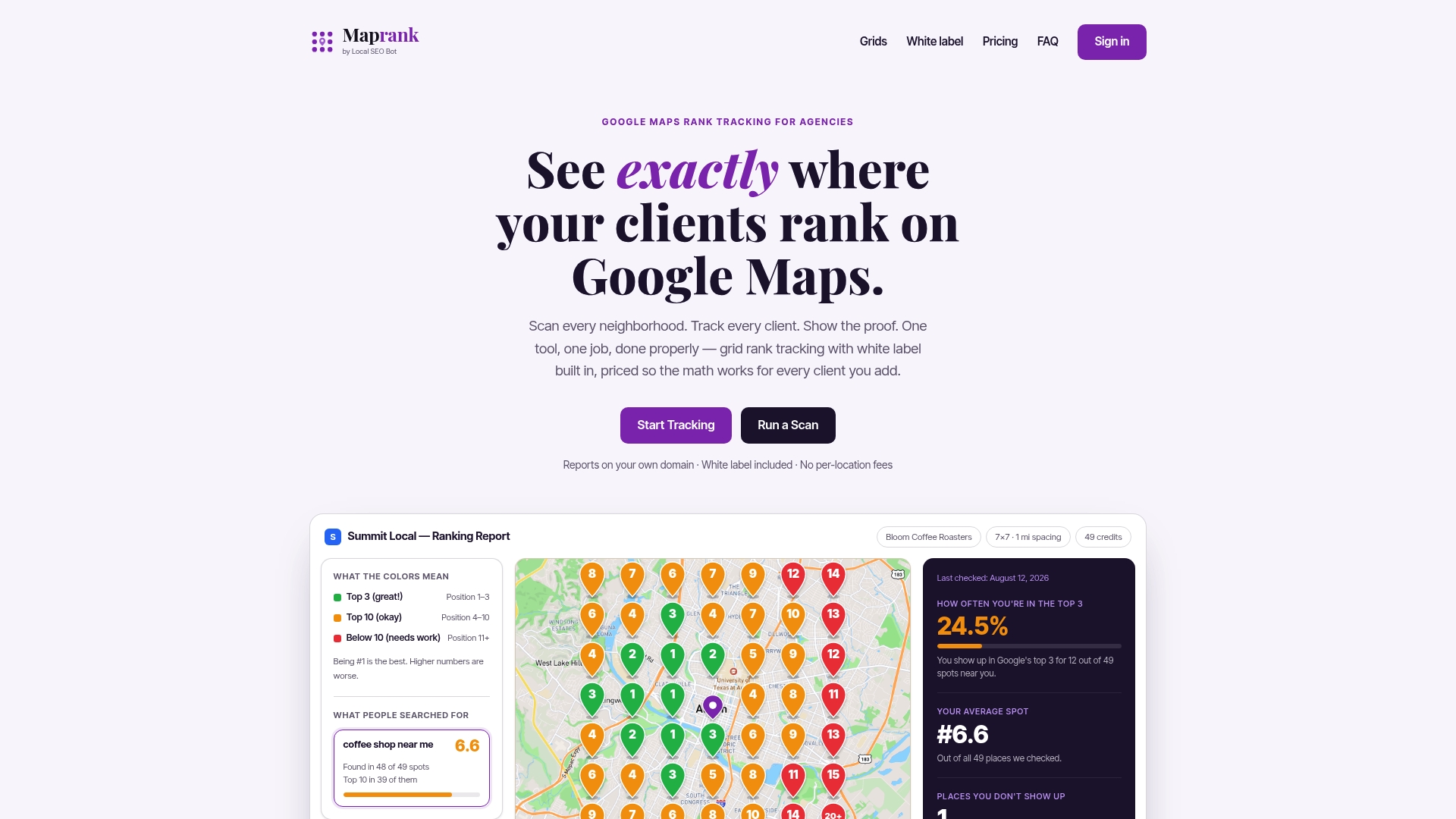
For reporting workflows, our guide to Google Maps rank tracking for SEO agencies shows how to turn scans into something a client reads and renews on.
Citation priorities by business type
The right mix of listings depends on what you sell and how customers choose you.
- Service-area businesses (plumbers, locksmiths, cleaners): get the main general directories right, then focus on the service-area details and one consistent phone number. A locksmith, for instance, benefits from understanding how competitor research feeds local visibility; this step-by-step local SEO guide for locksmiths walks through it for one trade.
- Healthcare and dental practices: industry and insurer directories matter as much as general ones, and provider names and addresses change when staff move. See our local SEO for dentists guide.
- Restaurants: menus, hours and reservation links change often, so the cost of stale data is high. Our local SEO for restaurants article covers the details.
- Multi-location brands: the canonical sheet matters most here. Each location needs its own listing and its own local page, never a shared phone number.
If you are weighing whether to hire help, our overview of Google Maps SEO services lists what a legitimate engagement includes.
Red flags in citation offers
Be skeptical when you see:
- Guaranteed rankings. Google documents no such lever.
- Huge volumes at tiny prices. Thousands of submissions for a flat fee usually means automated listings on sites no customer visits.
- No ownership. If the vendor creates accounts in their name, you may be unable to edit your own listings later. Insist on access.
- No before-and-after report. A vendor should show what was wrong and what changed.
- Fake or shared addresses. A listing for an address where you have no staffed presence conflicts with Google’s guidelines on addresses and signage.
FAQ
Do citations still help Google Maps rankings?
They help, mostly by keeping your information consistent and verifiable. Search Engine Land’s 2025 guidance says structured listings remain valuable for discoverability and trust, though their direct algorithmic influence may be weaker than once assumed. Treat them as maintenance, not a growth hack.
How many citations do I need?
There is no official number. Start with the major general directories, the mapping services, and the directories specific to your industry and city, and keep each one accurate. A smaller set you can maintain is better than a long list that goes stale.
Why did my Google Maps ranking drop?
Common causes are a profile edit, a stronger competitor, conflicting listing data, a website problem or a verification issue. Check the drop by query, location and device, and whether it is persistent, before you change anything. A grid scan shows whether the loss is local to a few areas or across your whole service area.
Should I pay for citation building?
Pay only for work you can verify: a report of what was wrong, listings created under accounts you own, and a clear fix list for duplicates. Avoid bulk packages and anyone promising a position. For a one-location business, the audit steps above can be done yourself in an afternoon.
What is the difference between structured and unstructured citations?
Structured citations are directory-style listings with set fields for name, address and phone. Unstructured citations are mentions in articles, blogs, podcasts, social posts and forums. You manage the first kind directly and earn the second through visibility in your community.
Sources
- Structured vs Unstructured Citations for Local SEO, Search Engine Land
- What Are Local Citations?, Shopify
- Understand how Google sources and uses info in Business Profile, Google Business Profile Help
- How Google sources and uses information in local listings, Google Local Listings Help
- Guidelines for representing your business on Google, Google Business Profile Help
- Why did my site traffic drop?, Search Console Help