Improve Google Maps Rankings in 30–90 Days: Grid Scans for Agencies
Improve Google Maps Rankings in 30–90 Days: Grid Scans for Agencies
Fix your primary category, complete your Google Business Profile, and start collecting reviews on a steady cadence. Category and profile fixes often get re-evaluated within 2 to 4 weeks, while review and citation work takes 1 to 3 months to move your position in the local pack. Distance from the searcher you can’t control. Everything else, you can measure with neighborhood-level grid tracking instead of guessing.
TL;DR:
- Claim, verify, and complete your Google Business Profile swiftly, focusing on accurate business name, map pin, primary category, local phone, website, and hours for quick re-evaluation.
- Choose the most specific, relevant primary category and consistently update your Services, reviews, and photos to strengthen relevance and prominence signals.
- Fix discrepancies in NAP information across all online listings and merge duplicates to prevent diluted visibility and improve local ranking consistency.
- Maintain activity with weekly photo uploads, posts, prompt review responses, and helpful Q&A to signal an actively managed and authoritative listing.
- Use grid-based rank tracking to measure actual visibility across neighborhoods, analyze data to prioritize areas for review campaigns, partnerships, and citation improvements.
Table of Contents
- Improve Google Maps Rankings by Verifying and Completing Your Business Profile
- Choose Categories, Expand Services, and Build Review Momentum
- Fix NAP Inconsistencies and Local Citation Errors
- Keep Your Profile Active With Posts, Q&A, and Fast Replies
- How Do You Measure What Actually Moved the Needle?
- Your 30 and 90-Day Google Maps Ranking Checklist
- Engage With the Local Community Through Partnerships and Sponsorships
- Manage and Improve Local Citations Beyond Basic NAP Consistency
- Use Google Posts Strategically to Promote Offers and Events
- Leverage Google Maps Q&A by Providing Helpful Answers
- What Small Teams Get Wrong About Maps Rankings
- Turn Grid Data Into a Client-Ready Report
- Sources
- FAQ
Improve Google Maps Rankings by Verifying and Completing Your Business Profile
Google ranks local results on three factors: relevance, distance, and prominence. It explicitly says a complete and verified Business Profile increases your odds of showing up for nearby searches. That’s the starting line, not a side task.
Claim your listing through Google Business Profile and verify it by phone, postcard, or video, depending on what Google offers your business type. Postcard verification may take several days to arrive by mail; phone and video verification can confirm instantly in eligible categories.
Once verified, prioritize these fields before anything else:
- Exact legal business name, matching your signage and website exactly
- Correct map pin, dropped on the actual entrance, not the building centroid
- Primary category, chosen for accuracy rather than ambition
- A local phone number with a matching area code, since toll-free numbers can read as less locally credible
- Working website link and complete hours, including holiday and special hours
Completing these fields today often triggers Google’s re-evaluation within 2 to 4 weeks. It’s the single fastest lever you have.
Choose Categories, Expand Services, and Build Review Momentum
Your primary category carries more ranking weight than most owners realize, and it’s worth getting obsessively specific about.
- Pick the narrowest accurate primary category. “Italian Restaurant” beats “Restaurant.” “Emergency Plumber” beats “Plumber” if that’s genuinely most of your work. Only add secondary categories you can actually back up with services performed.
- Fill out the Services section with customer language. List entries the way someone searches, not the way your invoice reads. “Drain snaking” and “clogged sink repair” both belong if you do both.
- Build a review-collection habit. Ask at the moment of peak satisfaction, right after a job finishes or a purchase completes. Use a direct review link or a printed QR code at checkout. Reply to every review, good or bad, within a few days.
- Upload photos weekly. Mix exterior shots, interior shots, team photos, and finished work. Sprout Social’s research links steady photo and post activity to stronger local visibility.
Review velocity and category accuracy work together. One fills the relevance signal, the other fills the prominence signal; Google weighs both.
Fix NAP Inconsistencies and Local Citation Errors
Your name, address, and phone number (NAP) need to match, character for character, everywhere they appear online. A mismatched suite number or an old phone line sitting on a data aggregator confuses Google’s matching algorithm and dilutes your prominence signal.
Run a manual audit across your website, Google Business Profile, and the major data aggregators (Data Axle, Foursquare, and any directory where your business shows up in a search for its own name). Fix discrepancies at the source, then let them propagate.
- Search your business name plus city to find duplicate or outdated listings
- Claim and merge duplicates instead of leaving two competing profiles
- Embed a Google Map on your contact page and add city-specific landing pages if you serve multiple areas
- Add LocalBusiness schema markup to your site and validate it with Google’s Rich Results Test
- Hand schema implementation to a developer if you’re not comfortable editing site code directly; a practical schema guide covers the markup itself if you want to attempt it yourself
Pro Tip: Duplicate listings often outrank the real one because review counts and citation signals get split between two profiles. Merging them can produce a visible ranking jump within weeks, with no new content or links required.
Keep Your Profile Active With Posts, Q&A, and Fast Replies
A profile that goes quiet looks abandoned to Google, and abandoned listings lose ground to competitors who show signs of life. The fix doesn’t require a marketing team, just a repeatable weekly habit.
- Upload at least one new photo per week
- Publish one “What’s New” post covering a promotion, event, or update
- Reply to every new review within 48 hours
- Seed your own Q&A section with the three or four questions customers actually ask, answered before a stranger posts a wrong guess
Stale profiles, meaning no new photos or posts in 30-plus days, tend to get quietly demoted in competitive markets. Consistency here matters more than volume. A local backlink from a chamber of commerce or a partner business adds to this same prominence signal over the following months.
How Do You Measure What Actually Moved the Needle?
Checking your own ranking from your office or your phone tells you almost nothing useful, because Google’s results shift based on exactly where the searcher stands. A customer three blocks north might see you in the top three, while a customer eight blocks south might not see you at all. Single-point checks paper over that entire pattern.
Grid-based rank tracking solves this by scanning dozens of points across your service area and mapping your position cell by cell, which is essential for representing true visibility instead of one lucky or unlucky spot check.
Track these metrics on a repeatable schedule:
- Percentage of grid cells where you appear in the local pack
- Median position across all scanned cells, not just the best one
- Review velocity (new reviews per week or month)
- Profile actions: calls, direction requests, and website clicks
A grid scan often reveals that a competitor dominates one neighborhood while sitting weak in another two blocks over, which tells you exactly where to point your next review-collection push. Agencies running white-label reports from this data can show clients cell-by-cell progress instead of a single vague number. Rescan every 2 to 4 weeks to match the timeline for relevance fixes, and monthly after that to track slower prominence gains.
Your 30 and 90-Day Google Maps Ranking Checklist
Spreading fixes across a defined timeline keeps a small team from trying everything at once and finishing nothing.
- Week 1: Verify your profile, correct the primary category, complete every core field, fix NAP mismatches, and merge duplicate listings.
- Weeks 2 to 4: Expand your Services section, start the weekly photo and post cadence, launch your review-request process, and add LocalBusiness schema to your site.
- Months 2 to 3: Keep review velocity steady, pursue two or three local citation or backlink opportunities, publish local landing pages if you serve multiple areas, and run a grid scan to see what actually shifted.
| Period | Focus | KPI to watch |
|---|---|---|
| Week 1 | Verification and profile accuracy | GBP completeness, category correctness |
| Weeks 2 to 4 | Services, photos, first reviews | New reviews per week, posts published |
| Months 2 to 3 | Citations, backlinks, iteration | Grid pack percentage, median position |
Set goals against your own baseline grid scan, not a generic industry number. A listing plateaued at positions 6 through 12 usually optimized only one factor; sequencing category, then reviews, then activity tends to move it without a single new backlink.
Engage With the Local Community Through Partnerships and Sponsorships
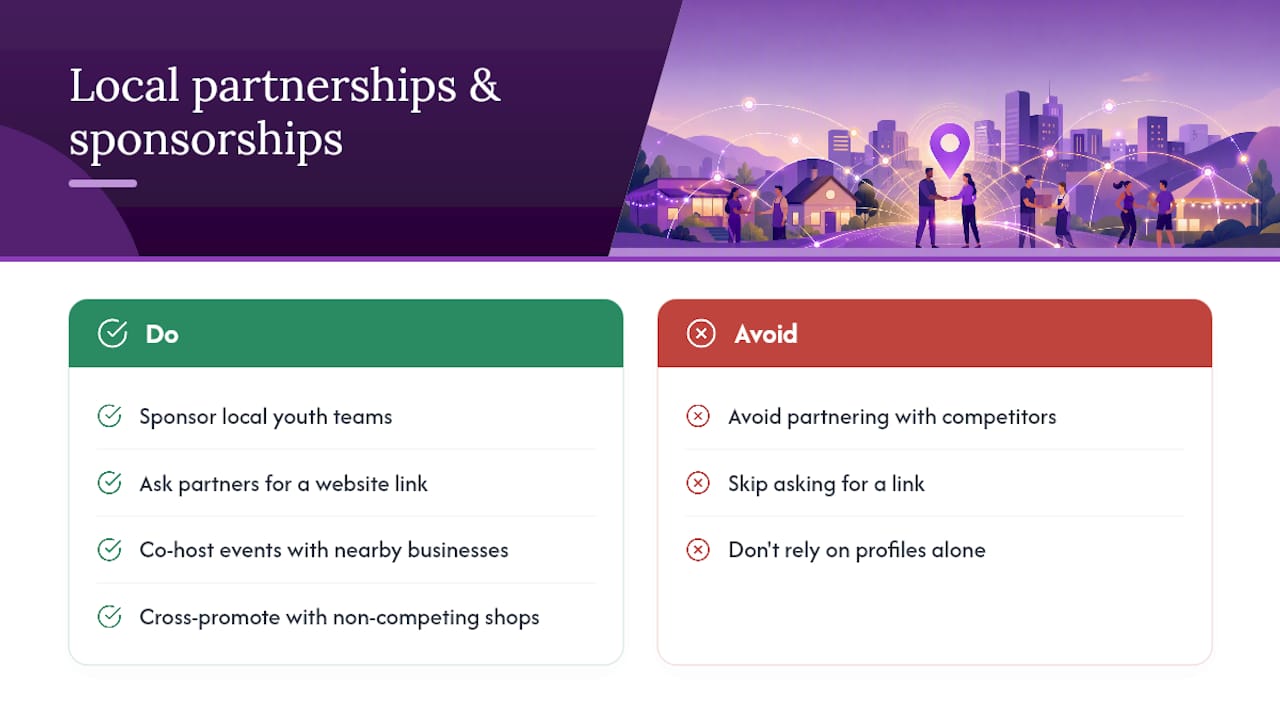
Sponsoring a youth sports team, co-hosting an event with a neighboring business, or donating to a local school fundraiser does more for your Maps ranking than it looks like on the surface. Each of these relationships tends to generate a local backlink, a mention on a partner’s website, or a citation on an event page, all of which feed the prominence signal Google uses to rank you.
Start with organizations that already publish an online presence: a little league team with a sponsor page, a farmers market with a vendor directory, a community foundation that lists donors. Ask specifically for a link back to your website when you sponsor something. Many organizations will add it without being asked twice, but you have to make the request part of the arrangement, not an afterthought.
Cross-promotion with nearby, non-competing businesses works the same way. A bakery and a coffee roaster sharing a joint event, or a gym and a physical therapy clinic referring customers to each other, both create natural citation and link opportunities that a directory listing never will. These relationships also tend to generate reviews from people who found you through the partner, which stacks on top of the citation value.
None of this replaces the profile and review work covered earlier. It compounds it. A business with a complete profile and a steady stream of local mentions and backlinks builds prominence faster than one relying on Google Business Profile activity alone.
Manage and Improve Local Citations Beyond Basic NAP Consistency
Matching your name, address, and phone number across directories is the floor, not the ceiling. Citation quality matters as much as citation consistency, and that’s where most local businesses stop looking too early.
Not all citations carry equal weight. A listing on an industry-specific directory relevant to your field, a chamber of commerce site, or a local news mention tends to carry more signal than a generic data aggregator entry that exists mostly for SEO purposes. Prioritize getting listed accurately on the platforms your actual customers used to find businesses like yours, whether that’s a niche trade directory or a regional business association.
Beyond accuracy, watch for citation completeness. A listing with just your name and phone number provides less context than one that includes your category, a description, hours, and photos. Fill out every field a directory offers rather than the bare minimum required to appear.
Periodically re-audit your citation footprint every few months, since businesses move, phone numbers change, and directories sometimes pull data from outdated sources without notice. A citation that was correct a year ago can quietly drift out of sync with your current profile, undermining the very consistency you worked to establish. Treat this as ongoing maintenance, not a one-time project you finish and forget.
Use Google Posts Strategically to Promote Offers and Events
Google Posts sit directly on your Business Profile and give you a way to push time-sensitive content, offers, and events straight into what searchers see before they even click through to your website. Treat them as a lightweight, recurring channel rather than a box to check once.
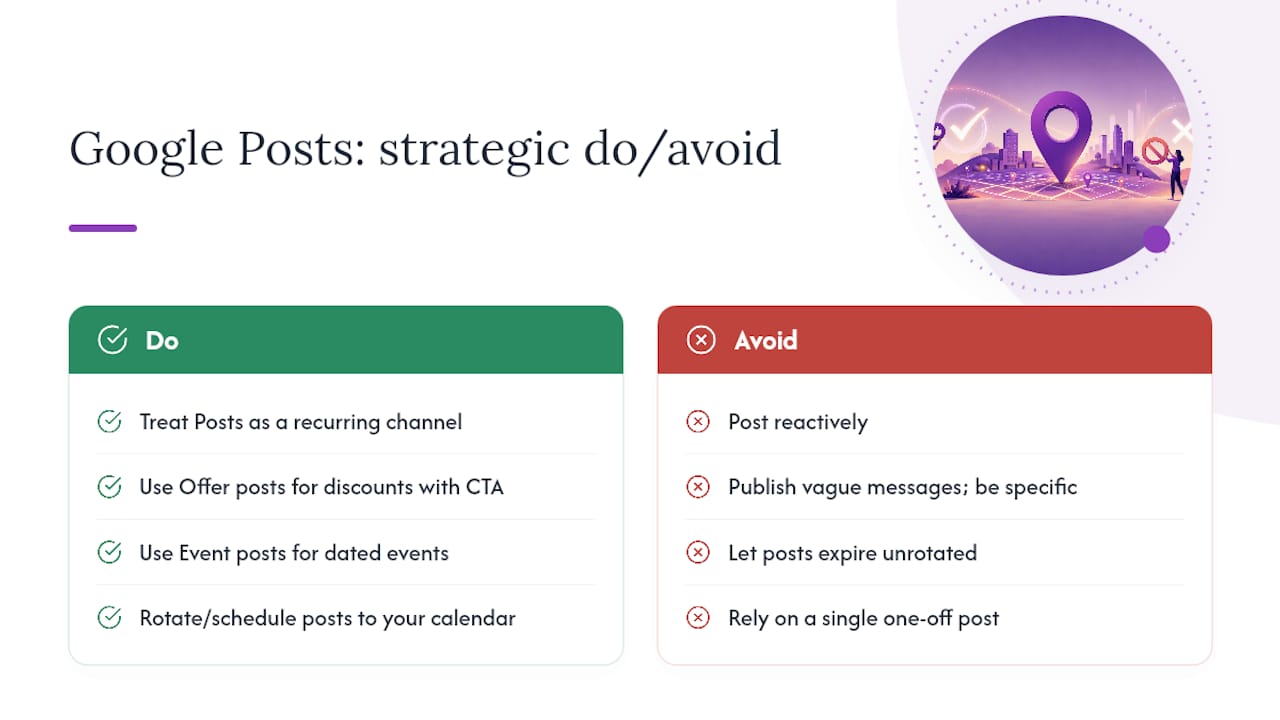
Offer posts work best for discounts, seasonal promotions, or limited-time deals, and they display with a clear call-to-action button that drives directly to your booking page or phone number. Event posts fit workshops, sales, grand openings, or anything with a start and end date. Both formats give Google fresh, dated content to associate with your listing, which reinforces the activity signal covered earlier in this article.
Keep each post short and specific: what the offer is, when it ends, and what action to take. A vague post advertising “great deals this week” performs worse than one stating the exact discount and expiration date, because specificity matches what searchers are actually scanning for.
Rotate posts on a schedule tied to your actual business calendar rather than posting reactively. If you run a weekly special, post it every week on the same day. If you sponsor a seasonal event, schedule the post to go live as soon as details are confirmed. Posts typically expire after seven days unless tied to a longer event window, so a stale, unrotated Posts feed undercuts the same freshness signal that weekly photos and review replies build elsewhere on your profile.
Leverage Google Maps Q&A by Providing Helpful Answers
The Questions and Answers section on your Business Profile is public, editable by anyone, and often ignored by the business it’s attached to. That’s a mistake, because unanswered or incorrectly answered questions sit in front of every searcher who scrolls that far down your listing.
Seed the section yourself before customers do. Post the three or four questions you get asked most often, whether that’s about parking, payment methods, appointment requirements, or accessibility, and answer them clearly and completely. This preempts a stranger posting a guess that turns out to be wrong, which then sits publicly attached to your business until someone corrects it.
Monitor the section regularly, ideally as part of the same weekly check where you reply to reviews. Anyone can answer a question on Google Maps, including competitors or people with no real knowledge of your business, so an unmonitored Q&A section can quietly accumulate bad information. Answering promptly and accurately signals to both searchers and Google that the profile is actively managed, which folds into the same activity and prominence signals covered in the profile maintenance section above.
Treat Q&A as a small extension of your customer service, not a separate task. The upvote feature lets useful answers rise to the top, so a clear, complete answer posted early tends to stay visible longer than a rushed one added later.
What Small Teams Get Wrong About Maps Rankings
Most small teams chase the wrong sequence. They’ll run a review campaign before fixing an inaccurate category, or redesign a website before verifying the Business Profile that actually shows up in search. Verification, category accuracy, and a steady review cadence come first, because they’re the cheapest fixes with the fastest re-evaluation window.
Measurement is what separates progress from guesswork. A single search from your own phone tells you almost nothing about how you rank three neighborhoods over. Track the trend across your service area, not a snapshot from wherever you happen to be standing.
Use the 30 and 90-day checklist as a structure, not a script. Stretch the timeline if your team is one person; compress it if you have staff to split the work.
— Local
Turn Grid Data Into a Client-Ready Report
Manual spot checks and screenshots don’t hold up when a client asks for proof their ranking actually improved. Maprank runs customizable scan grids across a business’s entire service area and turns the results into white-label reports on your own domain.
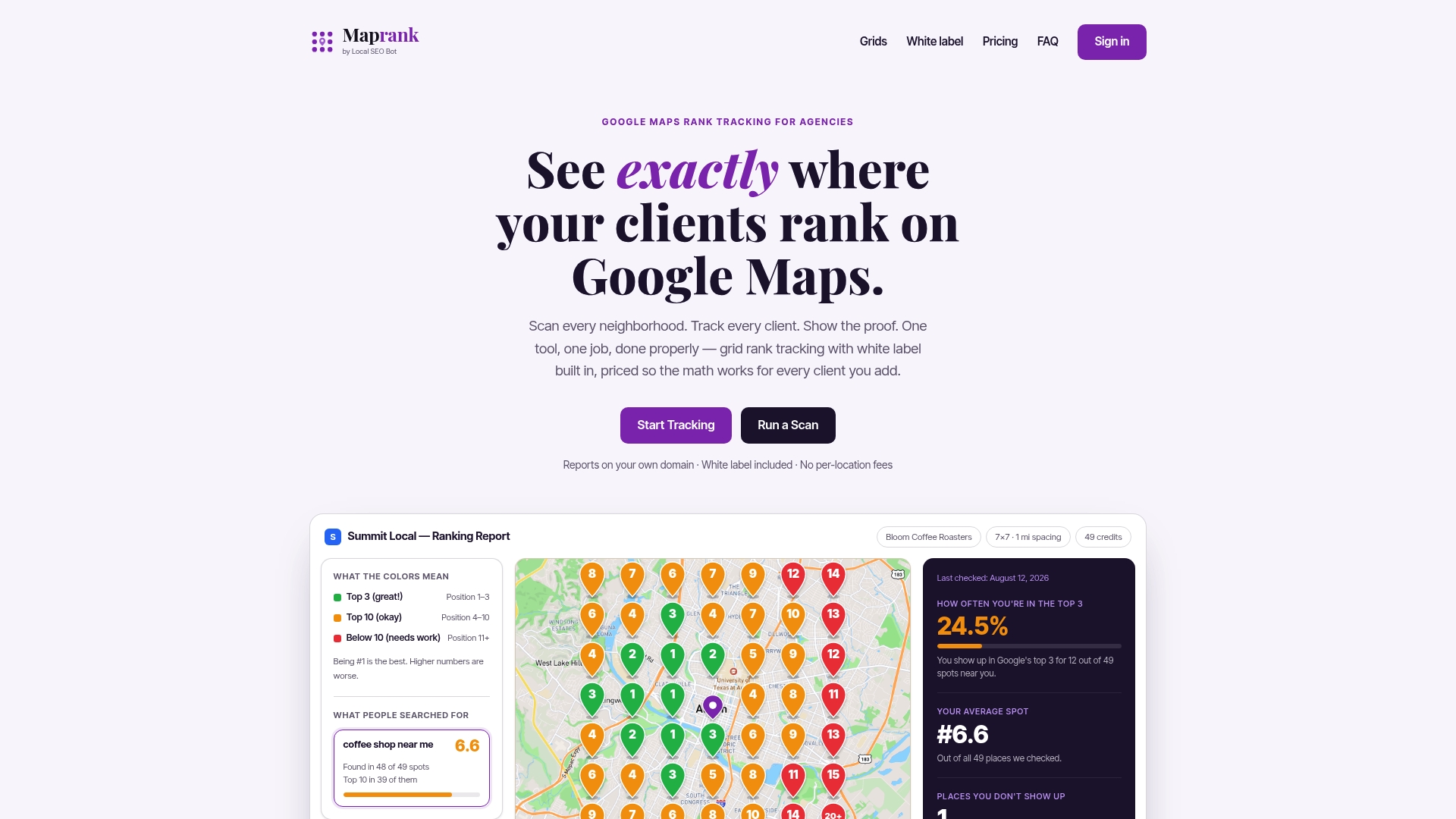
Instead of eyeballing one search result and hoping it represents the whole neighborhood, you get a cell-by-cell map showing exactly where a listing ranks and where it doesn’t, the same measurement approach described in the grid tracking section above. Agencies use this to show clients precise before-and-after data tied to the specific fixes made each month, which strengthens retention far more than a vague “rankings are improving” update.
Run a scan on your next client’s service area and see the coverage gaps for yourself with Maprank’s Google Maps rank tracker.
Sources
- Tips to improve your local ranking on Google
- Use Local SEO to Turn Signals Into Impact | Sprout Social
- How to Rank Higher on Google Maps: 12 Proven Actions for 2026 | Flento
- The 10 Best Ways to Rank Higher on Google Maps | WordStream
FAQ
How Do I Boost My Google Maps Ranking Quickly?
Fix your primary category and complete every field on your Google Business Profile first. Google often re-evaluates these fixes within 2 to 4 weeks, making them the fastest available lever.
How Long Does It Take to Improve Google Rankings Overall?
Category and profile fixes can shift within weeks, but prominence signals like reviews and citations typically take 1 to 3 months to meaningfully move a local pack position.
How Do I Improve Local SEO Beyond the Maps Listing?
Combine profile completeness with citation accuracy across directories, local backlinks from partnerships and sponsorships, and LocalBusiness schema on your website to reinforce the same relevance and prominence signals Google already weighs.
Is SEO Dead Now That AI Handles More Searches?
No. Google’s local ranking system still relies on relevance, distance, and prominence signals tied to a verified, active Business Profile, and those signals matter just as much when a searcher arrives through an AI-powered result.
How Do I Know Which Neighborhoods Need the Most Work?
A single search from one location doesn’t show how rankings vary block by block. Grid-based tracking tools like Maprank’s rank checker scan multiple points across a service area to reveal exactly where visibility drops off.