15–25 Questions to Lock Geo Grid Baselines for Local SEO Agencies
15–25 Questions to Lock Geo Grid Baselines for Local SEO Agencies

Before you touch a single ranking factor, four things need to be locked down: full account access, a measurable baseline, a completed intake questionnaire, and a signed scope with payment terms. Agencies that clear these early typically have their first report ready within a month, often showing initial movement in Local Pack visibility or call volume.
TL;DR:
- Securing complete account access, a clear scope, and a baseline from tools like Google Analytics and Search Console is essential before implementing SEO tactics.
- Proper onboarding includes verifying NAP consistency, addressing red flags such as duplicate listings, and establishing a review and content strategy aligned with client goals.
- Building a citation plan that prioritizes data accuracy and minimizes conflicting listings reduces future fix work, especially when integrated with NAP corrections.
- Using geo-grid rank snapshots and white-label reporting accelerates onboarding by providing neighborhood-level visibility and branded client updates.
- A focused, short kickoff meeting that reviews baseline metrics, confirms responsibilities, and aligns KPIs creates momentum and sets realistic expectations for client trust and project success.
Table of Contents
- Pre-onboarding checks: contracts, scope, payment, and red flags
- Access and permissions: what to request and how to request it safely
- Intake questionnaire: the focused 15 to 25 questions to collect up front
- Tracking and baseline: what to capture before you change anything
- First 30 days: the momentum month that builds trust
- Client responsibilities and expectations: what agencies need in return
- Kickoff meeting template and KPI alignment
- Why geo-grid rank snapshots and white-label reporting speed onboarding
- Local citation and directory submission planning
- NAP consistency checks and correction process
- Local link building strategy initiation
- Review acquisition and management plan
- Local content strategy alignment with client goals
- Practitioner note: eliminate onboarding friction with a short working kickoff
- Maprank: a practical fit for onboarding baselines
- Sources
- FAQ
Pre-onboarding checks: contracts, scope, payment, and red flags
Nothing stalls a project faster than starting technical work before the paperwork is settled. Confirm the statement of work, service level agreement, payment schedule, and cancellation terms before you request a single login.
Scope boundaries matter just as much as the scope itself. Spell out what is excluded, whether that is paid ads, web design, or multi-location rollouts, so the client does not assume local SEO covers everything marketing-related.
- Signed statement of work defining deliverables, timeline, and reporting frequency
- Payment schedule with invoice dates and late-payment terms
- Cancellation or pause clause with notice period
- Written list of exclusions (no ads, no site redesign, no reputation crisis management)
Watch for red flags that should pause onboarding entirely: a suspended Google Business Profile, duplicate or conflicting listings for the same location, or a history of manual penalties the client has not disclosed. Before anything else, agree on a single source of truth for the business’s legal name and address. Pull it from the client’s business registration or current signage, not from an old directory listing, since this becomes the reference point for every citation correction later.
Access and permissions: what to request and how to request it safely
Request access in a specific order so nothing blocks the work later. Never ask for passwords; use the invite systems each platform provides.
- Google Business Profile: request a manager invite through the profile’s People and access settings, not owner transfer, unless the agency is taking full account ownership
- Google Analytics or GA4: request Editor or Analyst role
- Search Console: request Full user access
- CMS admin or editor login for the website
- Hosting control panel access, even read-only
- Phone system or IVR access if call tracking will route through it
- Booking platform and review site logins relevant to the business
Google’s own guidelines for owners and managers note that newly added managers face a seven-day restriction on sensitive actions like removing an owner or transferring primary ownership, so build that delay into your onboarding timeline rather than treating it as a blocker. For agencies juggling several client locations, an organization account keeps things cleaner than adding each location to a personal Google account.
Log every access grant with the date it was given and who granted it, and set a reminder to revoke access when the engagement ends.
Pro Tip: Keep a simple spreadsheet of every access request, the date granted, and the login method used. It saves hours during offboarding.
Intake questionnaire: the focused 15 to 25 questions to collect up front
Long intake forms kill momentum before the project starts. Limiting the questionnaire to a focused set reduces onboarding fatigue and keeps clients engaged through the first week.
- Exact legal business name, any DBAs, and all phone numbers currently in use
- Physical address or, for service-area businesses, the full list of areas served
- Business hours, including seasonal or holiday variations
- Booking or scheduling flow and busiest days or times
- Return, cancellation, or refund policies that affect customer-facing pages
- Names of any previous SEO vendors and whether a manual penalty was ever issued
- Any history of citation edits or GBP suspensions
- Top three competitors the client watches closely
- Which service or location should be treated as the priority for month one
Nine to fifteen targeted questions covering identity, operations, and history, plus a handful on competitive context and priorities, is usually enough. Anything left unanswered gets resolved live in the kickoff call.
Tracking and baseline: what to capture before you change anything
You cannot prove progress without a starting point. Before making any changes, capture a full baseline and store it somewhere the client can review and approve.
- Connect or confirm access to the GA4 property and document current traffic levels
- Check Search Console coverage and note any existing indexing errors
- Pull Google Business Profile insights, including current queries and impressions
- Screenshot current Local Pack rankings for the business’s main service terms
- Compile the existing citation list across major directories
- Record call volume for the previous 30 to 90 days if call tracking is already in place
A geo-grid rank snapshot captures neighborhood-level map visibility that a single search query cannot show, since Local Pack results vary block by block in competitive markets. This matters because a business can rank first near its own address and disappear entirely three streets over, a gap a single keyword check would never reveal. Package the full baseline into a signed report with screenshots and CSV exports so the client has a dated record to compare against the first monthly report.
First 30 days: the momentum month that builds trust
The first month sets the tone for the entire engagement. Breaking it into weekly priorities keeps the client seeing progress instead of silence.
- Week one: confirm every access grant, capture baselines, and fix any critical Google Business Profile errors like wrong hours or categories
- Week two: correct citation inconsistencies and update on-page elements including titles, meta descriptions, and schema markup
- Week three: publish local content updates, start regular Google Business Profile posts, launch the review response plan, and identify local link prospects
- Week four: assemble the month-one report and walk the client through the next phase of the roadmap
Momentum in the first 30 days is less about dramatic ranking jumps and more about visible activity the client can point to.
Client responsibilities and expectations: what agencies need in return
Agencies can only move as fast as the client supplies what is needed. Set clear expectations for what the client owns.
- Signing contracts and approving proposals within the agreed window
- Providing content approvals, photos, and brand assets when requested
- Naming a single staff contact for day-to-day questions
- Responding to access requests and verification codes promptly
A reasonable standard is three to five business days for approvals and responses. Delays beyond that window push back the reporting cadence and should be documented, since a slow client response is the most common cause of a missed first-month milestone.
Kickoff meeting template and KPI alignment
The kickoff call is where loose ends from the intake form get closed and expectations get locked in. Thirty to sixty minutes is usually enough.
- Review the baseline numbers together so the client sees exactly where things stand today
- Confirm access is complete and reconfirm who owns which responsibilities
- Agree on the top three priorities for the first 90 days
- Choose one or two KPIs the client actually cares about, such as Local Pack visibility, call volume, direction requests, or booking conversions
- Set the reporting cadence, whether that is monthly or biweekly
Treating the kickoff as a working session rather than a presentation gives both sides a chance to align goals with measurable outcomes instead of leaving KPIs vague.
Pro Tip: Assign a due date to every open intake item during the kickoff call itself, not after. It turns loose ends into deliverables on the spot.
Why geo-grid rank snapshots and white-label reporting speed onboarding
Geo-grid scans plot ranking checks across a grid of points around a business rather than a single address, which is how agencies spot neighborhood pockets where visibility quietly drops off. Pairing that with white-label reporting cuts the time agencies spend rebuilding client-facing dashboards from scratch, since the export already carries the agency’s own branding. A rank-tracking subscription earns its cost the moment an agency manages more than one client location and needs repeatable baselines fast.
Local citation and directory submission planning
Citations are the directory listings, data aggregators, and industry-specific sites that reference a business’s name, address, and phone number. Planning this work during onboarding, rather than after, prevents duplicate or conflicting listings from undoing other optimization work later.
Start with an audit of where the business already appears, including general directories, data aggregators, and niche sites relevant to the industry. A roofing company needs different directories than a dental practice, so prioritize platforms that match the client’s category before chasing generic listing volume.
Build a submission list in tiers. Core data aggregators and the handful of general directories every business needs to come first. Industry-specific directories and local chamber or association listings follow once the foundation is clean.
Timing matters here. Submitting new citations before NAP corrections are finished just creates more inconsistency to fix later, so sequence citation work after the correction pass described in the next section, not before it. Set a realistic target, since directory approval can take anywhere from a few days to several weeks depending on the platform, and build that lag into the client’s monthly expectations rather than promising instant listings.
Document every submission with the date, the URL, and the login used, the same way you log platform access. It becomes the reference sheet for future audits and makes handoffs between team members painless if the account changes hands.

NAP consistency checks and correction process
NAP, meaning name, address, and phone number, needs to match exactly across every listing, website page, and citation. Inconsistent NAP data confuses the signals Google uses to match a business to local search queries, and it can slow down how quickly new citations get picked up.
Run a full audit against the single source of truth agreed on during pre-onboarding. Pull current listings from the major directories and aggregators, then compare each field character by character: suite numbers, abbreviations like “St.” versus “Street,” and phone number formatting all count.

Flag every mismatch in a tracking sheet with three columns: the directory, the current listing data, and the correct version. Prioritize corrections on high-authority directories and data aggregators first, since those feed smaller directories automatically over time.
Some corrections happen instantly through a directory’s self-service dashboard. Others require submitting a correction request and waiting for manual review, which can take a few weeks. Set client expectations accordingly, and revisit the NAP audit again around the 90-day mark to catch any new inconsistencies that crept in from old listings resurfacing.
Local link building strategy initiation
Local link building during onboarding starts with identifying realistic, relevant opportunities rather than chasing high-authority sites with no local connection. Local news outlets, chamber of commerce directories, industry associations, and community sponsorship pages tend to offer the most natural fit for a local business.
Begin by cataloging the client’s existing relationships: sponsorships, supplier partnerships, trade memberships, or community involvement that could translate into a legitimate link. These conversations are often faster to close than cold outreach because the relationship already exists.
Next, map competitor backlink profiles to spot patterns, such as a local blogger who regularly covers businesses in the client’s category or a regional publication that features local companies. Add these to a prioritized outreach list rather than treating link building as a volume game.
Set expectations early that this is a slower-moving piece of the plan compared to citation fixes or on-page changes. A handful of genuinely local, relevant links built steadily over several months outperforms a large batch of low-quality directory links acquired quickly.
Review acquisition and management plan
Reviews influence both how prominently a business shows up locally and whether potential customers convert once they find it. Build the review plan during onboarding so it starts running from week one rather than becoming an afterthought in month three.
Agree on a request process first: who sends the review request, through which channel (text, email, or a point-of-sale prompt), and how soon after a completed service or sale. Automating this step, even with a simple templated message, produces far more consistent results than relying on staff to remember.
Set a response protocol for both positive and negative reviews. Responses do not need to be lengthy, but every review deserves one, and negative reviews need a response window measured in hours, not days, to limit reputational damage. The client’s staff contact should either handle this directly or hand it to the agency with a clear tone guide.
Track review velocity and average rating as part of the monthly report. A steady increase in review count, even without a dramatic rating change, is itself a sign the acquisition process is working.
Local content strategy alignment with client goals
Content only earns its place in a local SEO plan when it maps back to what the client actually wants to grow, whether that is a specific service line, a new location, or a seasonal promotion. Pull this priority directly from the intake questionnaire rather than guessing.
Start with service-area and service-specific pages if the client’s current site lacks them, since these pages give Google clear, structured signals about what the business does and where. A plumbing company serving six towns needs distinct pages or clearly delineated sections for each area, not a single generic “service area” paragraph.
Layer in supporting content, such as blog posts answering common customer questions or seasonal guides tied to the business’s calendar, once the core pages are solid. This content supports the service pages rather than competing with them for the same keywords.
Revisit the content plan at the 30-day mark alongside the rest of the momentum-month report, and adjust priorities based on which pages are gaining traction in Search Console versus which ones need another pass.
Practitioner note: eliminate onboarding friction with a short working kickoff
Long questionnaires stall projects before they start. A focused 45-minute working kickoff closes the remaining gaps faster and builds trust sooner than any form ever will.
— Local
Maprank: a practical fit for onboarding baselines
Agencies juggling multiple client locations need a fast way to capture neighborhood-level baselines without fighting Google account integrations for every client. Maprank runs customizable grid scans and exports white-label reports on the agency’s own domain, with unlimited businesses included on every plan.
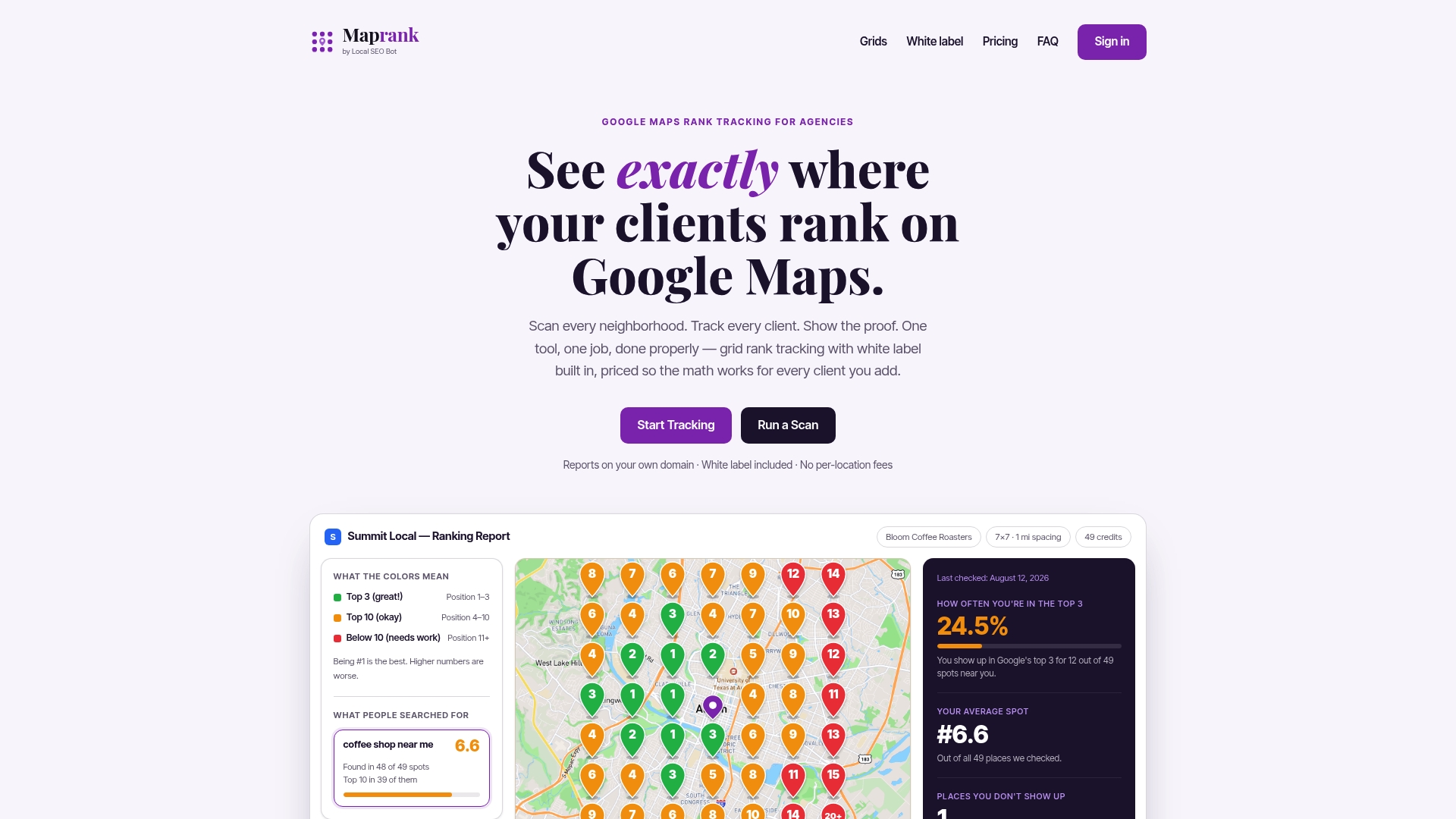
- Run a one-off rank check during onboarding week to lock in a baseline before any changes go live
- Use white-label exports to hand the client a branded first report without rebuilding a template from scratch
Set up a scan for your next onboarding at Maprank.
FAQ
What is the 80/20 rule in SEO?
In local SEO onboarding, that usually means prioritizing access, baselines, and GBP accuracy before smaller on-page tweaks.
How much should I pay for local SEO?
Pricing varies widely by agency, market, and scope, so there is no single standard rate. Ask any agency for a written statement of work tied to specific deliverables rather than comparing price alone.
Is SEO dead now with AI?
No. Local search still relies on Google matching relevance, distance, and prominence signals to a business’s profile, and that matching process still rewards accurate, complete local information regardless of how search results are displayed.
What will local SEO look like in 2026?
Expect continued emphasis on accurate Business Profile data, consistent citations, and genuine review activity, since these remain the core signals behind relevance, distance, and prominence. Agencies that build clean onboarding baselines now, including geo-grid rank snapshots, will have an easier time proving movement as search results continue to evolve.
What should be in a local SEO onboarding checklist?
A solid checklist covers signed scope and payment terms, full account access across Google Business Profile, analytics, and Search Console, a completed intake questionnaire, and a documented baseline before any changes begin. These four pieces let an agency prove progress from the very first monthly report.