45–480 Credits: Copy-Ready Grid Credit Planning for Agencies
45–480 Credits: Copy-Ready Grid Credit Planning for Agencies

Treat grid scan credits the way you treat any measurement budget: as a fixed resource you spend to get decision-quality data, not as a metric to maximize. Align the grid to the client’s actual service area first, then pool credits across similar clients to cut overhead.
TL;DR:
- Using grid scan credits effectively involves aligning the grid to the actual service area and pooling credits across similar clients to minimize overhead.
- The credits formula factors in locations tracked, keywords per location, grid points, and scan frequency, with adjustments for language, overlap, and seasonality.
- Smaller storefronts typically need only a 3x3 or 5x5 grid scanned monthly, while sprawling service areas require larger, more precise grids with more points.
- Accurate geocoding and verifying client coordinates are crucial to prevent misaligned scans and ensure meaningful geographic insights.
- Maprank’s Geo Grid Rank Tracker supports customizable grids and scalable credit plans, simplifying client onboarding and multi-business management.
Table of Contents
- Why credits are a measurement budget
- Step-by-step budgeting framework and the credits formula
- Practical scenarios and copy-ready templates
- Operational best practices for accuracy and reporting
- How to talk to clients about credit planning
- Maprank: an operational fit for credit-based grid tracking
- Primary sources and Maprank resources to cite
- Sources
- FAQ
Why credits are a measurement budget
Google says local ranking depends primarily on relevance, distance, and prominence, which means the same business can rank differently depending on where the searcher stands. A single rank check from one point tells you almost nothing about how a business performs across the neighborhoods it actually serves.
This is also why a rank position and a map label are not the same thing. Maps ranking involves separate systems for candidate retrieval and for what actually renders on screen, and industry analysis of Maps architecture points to a large number of internal signals feeding those systems. A business can retrieve well for a query and still render differently depending on zoom level, pack size, or nearby competition density.
That variability is the entire reason grids exist. One point measures one location’s experience of the algorithm. A grid of points, scanned on a regular cadence, measures the pattern: where a client dominates, where they are invisible, and where the boundary between the two sits. Credits fund that pattern-finding. Spend them on a single check and you get a snapshot that can mislead a client into thinking they rank well or poorly everywhere, when the truth is usually uneven and location-specific.

Step-by-step budgeting framework and the credits formula
Start with the formula itself:
credits = locations_tracked × keywords_per_location × grid_points × scans_per_period
Each variable has its own decision behind it.
- Locations tracked differs by business type. A storefront gets one grid centered on its address; a service-area business (plumbers, cleaners, mobile mechanics) needs a grid shaped to its territory, not a radius around an office it doesn’t want customers visiting, per Google’s service-area guidance.
- Keywords per location is the client’s priority search terms for that market, typically 3 to 8 for a small business and more for multi-category operators.
- Grid points depends on density and shape. A tight urban market might use a 5x5 square grid with 0.5 mile spacing, while a sprawling suburban service area often needs a polygon or hex grid weighted toward denser population pockets rather than uniform spacing.
- Scans per period is your cadence: weekly, biweekly, or monthly.
Modifiers push the number higher. Multi-language markets often need a parallel keyword set in each language. Overlapping service areas between two clients in the same category can justify sharing grid points instead of duplicating them. Seasonal businesses may need a temporary frequency increase around their peak months and a pullback the rest of the year.
Once you have a raw number, add a buffer.
Pro Tip: Start every new client at the lowest density that still covers their real service area, then increase grid points only where the first month’s scan shows meaningful geographic variation.
Practical scenarios and copy-ready templates
Template A, small storefront. A single-location bakery tracks 5 keywords with a 3x3 grid (9 points) scanned monthly. That is 5 × 9 × 1 = 45 credits per month before locations are multiplied in, and with one location, the total stays at 45.
Template B, service-area contractor. A residential plumber covering a metro area uses a 7x7 hex grid (roughly 40 points) to follow the service boundary instead of a storefront radius, tracks 6 keywords, and scans biweekly (2 scans per month). That’s 6 × 40 × 2 = 480 credits monthly. Dropping to a 5x5 grid (25 points) cuts that to 300 credits, worth testing first if budget is tight.

Template C, agency retainer. An agency pools credits across 8 similar small clients rather than buying separate allotments for each.
The quick heuristic: increase density when it changes a real decision, such as which neighborhood to target with paid ads or content. Increase it only for noise, like confirming a rank you already know is strong, and you’re spending credits without spending insight.
Operational best practices for accuracy and reporting
Grids waste credits fastest when they’re pointed at the wrong geography or the wrong coordinates.
- Build the grid around the client’s verified service area, not an arbitrary radius, so no points fall outside the practical buying zone.
- Verify addresses and LatLng coordinates before the first scan; Google’s developer documentation on search matching and listings covers geocoding and manual LatLng adjustment for cases where automated geocoding places a pin incorrectly.
- Set cadence by purpose: weekly during active optimization campaigns, monthly for steady-state monitoring, and event-triggered scans after a major algorithm update or a competitor’s aggressive move.
- Turn scans into white-label heatmaps and geographic visibility reports that show clients exactly where they win and lose, which justifies the credit spend in terms they understand as explained by Chrome Cactus Studio | Boutique SEO in Scottsdale, AZ.
Pro Tip: A single mis-geocoded pin can silently shift an entire grid a few blocks off target, so spot-check new client setups against a known landmark before running the first full scan.
How to talk to clients about credit planning
Frame credits as the unit that buys decisions, not the deliverable itself. In proposals, describe the grid size and cadence you’re proposing and tie it directly to what the client will learn: which neighborhoods to prioritize, where a competitor is gaining ground.
For overage, set a rule upfront rather than negotiating after the fact: extra scans beyond the monthly allotment either draw from a shared buffer or trigger a plan conversation, never a surprise invoice. During onboarding, include a sample report snippet and a one-line explanation of why the grid is shaped the way it is, so the client sees the logic before they see the numbers.
— Local
Maprank: an operational fit for credit-based grid tracking
Once the math is done, the tool needs to match it. Maprank’s Geo Grid Rank Tracker supports customizable grid shapes and spacing, so a service-area polygon and a tight storefront square are both configurable rather than forced into one template.
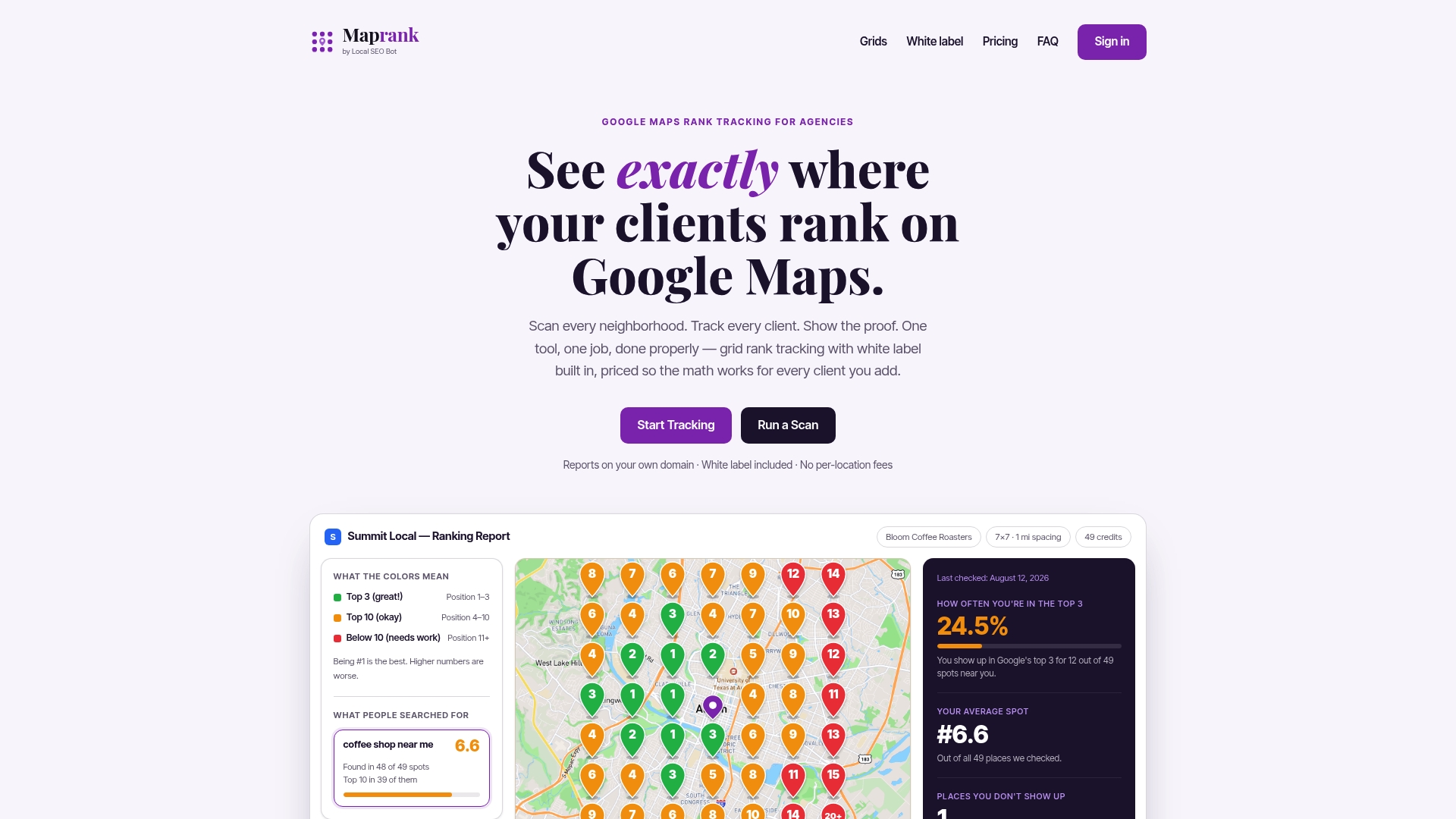
A few specifics worth knowing before you set up a client:
- Plans include white-label reporting and support multiple businesses, allowing pooling clients under one account without added per-seat costs.
- Credit-based pricing means the Maprank Solo, Agency, Pro, and Scale plans scale with scan volume rather than penalizing you for adding client accounts.
- No Google account integration is required to run a scan, facilitating quicker onboarding of new clients.
If you want to test the math from this article on a live account, the Maprank rank checker is the fastest starting point before committing to a plan.
Primary sources and Maprank resources to cite
For further reading: Google’s local ranking guidance, its service-area business guidelines, Maps developer documentation on geolocation accuracy, and Maprank’s Geo Grid Rank Tracker page.
Sources
- Tips to improve your local ranking on Google - Google Business Profile Help
- Search matching and listings — Google developer docs
- Inside Google Maps: 72 ranking signals and the architecture behind local search - Search Engine Land
FAQ
What counts as one credit in grid rank tracking?
One credit typically equals one keyword checked at one grid point during one scan, so a 9-point grid checking 5 keywords consumes 45 credits per full scan. Exact credit costs depend on the provider’s pricing structure, so confirm the ratio before budgeting a client.
How many grid points does a small business actually need?
A single storefront in a compact market usually gets useful data from a 3x3 or 5x5 grid, since relevance, distance, and prominence create meaningful variation even over short distances. Larger or sprawling service areas need more points to avoid gaps in coverage.
Should service-area businesses use a different grid shape than storefronts?
Yes, Google’s service-area guidance recommends representing territory accurately rather than centering visibility on an office address, so grids for these businesses should follow the real service boundary, often as a polygon or hex pattern rather than a simple square.
How often should agencies re-scan a client’s grid?
Weekly scans fit active optimization campaigns where rankings are expected to shift, while monthly scans suit stable, already-optimized listings. Event-triggered scans after an algorithm update or a competitor’s push add value without committing to a permanently higher cadence.
Can pooled credits work across multiple similar clients?
Pooling credits across clients with similar grid sizes and keyword counts reduces the overhead of buying separate allotments for each account. Agencies commonly reserve a shared buffer for experimental campaigns and reallocate unused credits at the next billing cycle rather than purchasing ad hoc top-ups.