4,000 Credit Monthly Bill: Local Rank Tracker Pricing for Agencies
4,000 Credit Monthly Bill: Local Rank Tracker Pricing for Agencies

Local rank tracker pricing splits into two camps: flat subscription tiers with bundled scan credits, or pay-as-you-go credit packs priced by grid size and scan frequency. Solo consultants usually start with plans costing tens of dollars a month, while agencies managing multiple clients often pay higher monthly fees depending on grid density and client count. Maprank targets the agency end of that range with transparent per-scan credits, no per-location surcharges, and white labeling included rather than upsold.
TL;DR:
- Local rank tracker pricing primarily depends on grid size, scan frequency, and total client locations, not on the number of businesses managed.
- Credit-based models are more cost-effective for clients with variable scan needs, while subscription tiers suit stable, predictable client rosters.
- Agencies should calculate actual credit consumption by multiplying locations, grid points, and scan frequency before comparing pricing plans.
- Maprank offers predictable, transparent pricing with included white labeling and unlimited businesses, ideal for multi-location agency clients.
- Be aware of hidden fees such as overage charges, seat add-ons, API costs, and export limits that can significantly inflate the final bill.
Table of Contents
- Local Rank Tracker Pricing Models Explained
- What Drives Your Monthly Rank Tracking Bill
- How Much Does Local Rank Tracking Actually Cost?
- How Do You Choose the Right Rank Tracker Plan?
- How Maprank Prices Rank Tracking for Agencies
- Cancellation Policies and Contract Flexibility
- Hidden Fees That Inflate Your Rank Tracking Bill
- What Agencies Get Wrong About Rank Tracker Pricing
- Try Maprank’s Transparent Pricing on Your Own Client Roster
- Sources
Local Rank Tracker Pricing Models Explained
Every vendor in this space prices its tool one of three ways, and knowing which model you’re looking at changes how you read the price tag entirely.
Subscription tiers bundle a fixed number of scan credits, a set number of seats, and often white labeling into a flat monthly fee. You know your ceiling going in, which makes budgeting for a client roster simple, but you can end up paying for capacity you don’t use during slow months.
Credits or per-scan pricing charges based on actual usage. Run a dense grid with 49 geo-points across five clients every week, and you’ll burn credits fast; check a single business monthly and you barely touch your balance. This model tends to be more cost-effective for agencies whose clients vary wildly in scan needs, since local rank positions change by GPS point and a sparse grid for a rural client costs a fraction of a dense urban one.
Free trials and starter credits round out the market. Several tools offer 14-day trials or limited free checks so you can test grid accuracy before paying anything.
Common variants worth watching for:
- Annual billing that offers a significant discount off the monthly rate
- Marketplace deals, like tiered lifetime licenses sold through platforms such as AppSumo
- “Starter” tiers that cap grid size even though the credit count looks generous
- Add-on credit packs you can buy mid-cycle without upgrading your whole plan
What Drives Your Monthly Rank Tracking Bill
Six factors decide whether you land near the bottom or top of any pricing table, and most of them compound with each other.
- Scan frequency. Daily scans burn through credits roughly four to seven times faster than weekly scans, depending on the vendor’s schedule options.
- Grid density. A 9-point grid costs a fraction of a 49-point or 100-point grid because each point is a separate scan.
- Number of locations and clients. This is the multiplier that turns a $50 plan into a $300 one once you cross five or six active clients.
- Seats, white label, and API access. Agency plans often gate these behind mid or top tiers rather than including them by default.
- Support level and SLAs. Faster response times and dedicated account management usually sit on the highest tier.
- Overage fees and add-ons. Exceeding your credit allotment can trigger per-credit charges that aren’t obvious from the sticker price.
One phrase deserves extra scrutiny: “unlimited businesses.” Vendors frequently qualify this claim elsewhere in the fine print, capping grid points, seats, or monthly export volume even while the business count itself has no ceiling. Read the feature list past the headline, not just the price column.
Pro Tip: Ask for the exact credits-per-scan formula before you sign anything. If a sales rep can’t tell you how many credits a 25-point grid on a weekly cadence consumes, that vendor’s pricing page is hiding more than it’s showing.
How Much Does Local Rank Tracking Actually Cost?
Real budgets vary by how many clients you’re tracking and how aggressively you scan them, but three tiers show up consistently across the market.
Solo or starter tiers run roughly $20 to $50 a month and usually cap you at one or two businesses, a small grid (often 9 points), and weekly scans. Fine for a single-location shop testing the waters, tight for anyone managing client work.
Agency starter plans sit closer to $80 to $150 a month, typically including a credit bundle sized for five to eight clients on modest grids, plus white labeling. Burn through that allotment and you either buy a top-up pack or move up a tier.
Mid-market and enterprise plans climb toward $250 to $500-plus monthly, built for agencies running dense grids, daily or near-daily scans, and larger client counts with dedicated support.
Here’s a worked example most agency owners actually need: 10 clients, averaging 4 locations each, on a 25-point grid, scanned weekly.
| Variable | Value |
|---|---|
| Clients | 10 |
| Avg. locations per client | 4 |
| Grid points per location | 25 |
| Scans per week | 1 |
| Total scans/month | Locations × 25 points × 4 weeks equals a few thousand scans per month |
That 4,000-credit monthly burn is the number to hold against any vendor’s credit price to get a real dollar figure, since converting usage into a monthly credit estimate is the only honest way to compare plans. Annual billing typically provides a significant discount off that total, which on a 4,000-credit workload can mean real savings over a year.
How Do You Choose the Right Rank Tracker Plan?
Start with what a trial should actually measure, not just whether the dashboard looks clean.
- Track grid accuracy against known rankings you already trust.
- Log exactly how many credits a realistic client scan consumes.
- Test white-label report generation with your own branding.
- Confirm export formats work with your existing client reporting workflow.
- Push a client’s location count past the advertised “unlimited” language and see what actually breaks.
Before committing, ask the vendor these directly:
- What exactly does one credit buy: one grid point, one keyword, or one full scan?
- What happens when I exceed my monthly credit allotment?
- Does “unlimited businesses” cap grid size, seats, or exports anywhere?
- Is white labeling included on every tier or gated behind a premium plan?
- How many seats come standard, and what does an extra seat cost?
- Is API access available, and is it metered separately from scan credits?
- Can I downgrade mid-cycle if my client count drops?
- Do unused credits roll over, or do they expire monthly?
- Is there a cancellation fee or minimum term?
- What’s the refund policy if the trial doesn’t match production accuracy?
Watch for pricing language that hedges on specifics, vague terms like “fair use” without a number attached, or contracts that lock you in annually with no monthly exit. Structure your own test over 14 to 30 days using your busiest real client, not a demo account, and track credit consumption daily so the number you get at the end reflects genuine usage rather than a light sales-demo scenario.
How Maprank Prices Rank Tracking for Agencies
Maprank builds its pricing around a simple idea: agencies should pay for scan volume and grid size, not for how many client businesses they manage. Every plan includes unlimited businesses and white labeling as a baseline, not an upsell, which removes the per-location fee structure that inflates so many competing tools once an agency roster grows past a handful of clients.
This setup fits a specific agency profile best: shops juggling multiple multi-location clients who need predictable monthly costs rather than a bill that swings depending on how many businesses they onboarded that month. A grid-based tracking approach with transparent credit pricing means an agency can forecast next quarter’s spend using the same client-locations-grid math covered earlier in this article, rather than guessing at hidden per-business charges.
Reported outcome: Some product pages describe improved map pack visibility and clearer identification of coverage gaps for agencies running grid scans across client territories, though exact percentage lifts vary by market and grid configuration.
Agencies evaluating Maprank against other tools should weigh their own client mix against this model directly:
- Multi-location clients benefit most, since per-business fees would otherwise stack fast.
- Agencies with fewer than three clients may find flat subscription tiers elsewhere comparably priced.
- Teams that need branded client reports get white labeling without a tier upgrade.
Cancellation Policies and Contract Flexibility
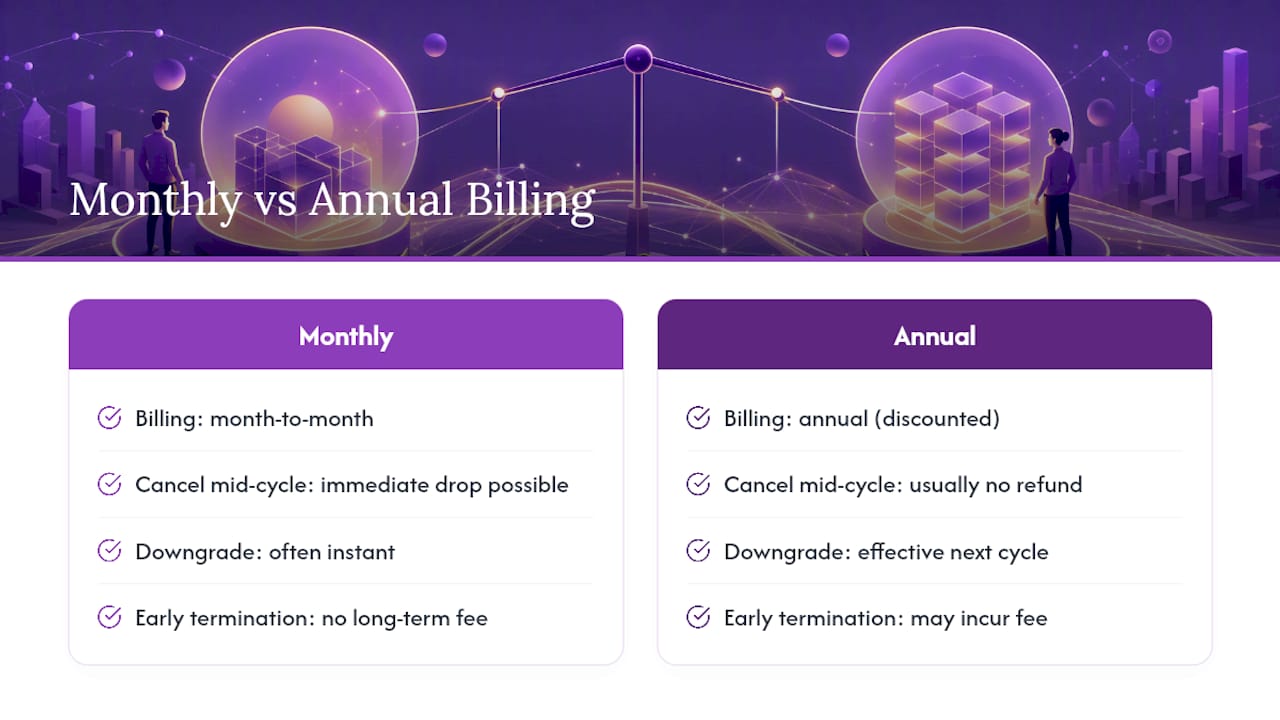
Most local rank trackers sell month-to-month plans as the default, with annual billing offered as a discounted upgrade rather than a requirement. That structure matters more than it looks: a monthly plan lets you drop or shrink your subscription the moment a client roster shrinks, while an annual commitment locks in a rate that only pays off if your usage stays steady or grows.
Before signing anything, check three specific things. First, whether canceling mid-month refunds unused credits or simply lets the plan lapse at the renewal date. Second, whether downgrading tiers is instant or takes effect only at the next billing cycle. Third, whether annual plans carry an early termination fee if you need out before the term ends.
Agencies with volatile client counts, the kind that gain and lose accounts every quarter, generally do better on flexible monthly billing even at a slightly higher per-month rate. The savings from an annual discount rarely offset the cost of paying for a client roster you no longer have. Agencies with a stable, predictable base of long-term clients are the ones who actually benefit from locking in an annual rate.
One more detail worth confirming directly with support: some vendors treat “cancel anytime” as canceling future renewals only, not stopping the current billing cycle. That distinction affects whether you get a partial-month refund or simply lose access at the end of a period you already paid for.
Hidden Fees That Inflate Your Rank Tracking Bill
Base pricing rarely tells the whole story. The gap between the advertised monthly rate and what actually hits your card tends to come from a handful of predictable add-ons.
Overage charges top the list. Cross your credit allotment mid-cycle and many vendors bill per additional credit at a rate noticeably worse than your plan’s built-in price per credit. Seat add-ons come next: a plan that looks affordable at three seats can double in cost once you add two more team members for client access.

API access is another common gate. Some tools include it standard; others charge a flat monthly fee on top of your base tier, or meter API calls separately from scan credits entirely. Data export limits catch agencies off guard too, particularly when a client requests a full historical export and the plan only permits a capped number of exports per month before charging extra.
White-label branding sometimes carries a surprise cost as well. A handful of vendors advertise white labeling as a headline feature, then reveal it’s locked to their two highest tiers once you actually go shopping for it. Support tier upgrades and onboarding fees round out the list, particularly on enterprise-level contracts where a “dedicated account manager” gets billed as a separate line item.
The fix is simple even if it’s tedious: request the full pricing schedule, not just the plan comparison page, before you commit a client budget to any tool.
What Agencies Get Wrong About Rank Tracker Pricing
Most agencies shop for rank trackers the way they shop for software generally: compare sticker prices, pick whichever plan fits the monthly budget, sign up. That approach misses the actual variable that determines cost, which is grid density multiplied by client count multiplied by scan frequency. Two vendors advertising the same $99 entry price can produce wildly different real-world bills once you plug in your actual client roster.
The conventional advice, “just compare the pricing pages,” falls short because pricing pages describe capacity, not consumption. A plan with 5,000 monthly credits sounds generous until you realize your specific mix of ten multi-location clients on dense grids burns through that allotment in twelve days.
What agencies should prioritize first is running the exact math from this article, locations times grid points times scan frequency, against their real client list before comparing a single price tag. Only after that number exists does a vendor’s per-credit rate or flat tier price mean anything concrete. Pricing transparency matters, but transparency without a usage calculation is just a number sitting on a page.
— Local
Try Maprank’s Transparent Pricing on Your Own Client Roster
Maprank removes the per-location fee structure that makes so many rank trackers unpredictable for agencies. No surcharge per business, white labeling built into every plan, and credit pricing you can calculate in advance using the exact locations times grid points times frequency formula covered above.
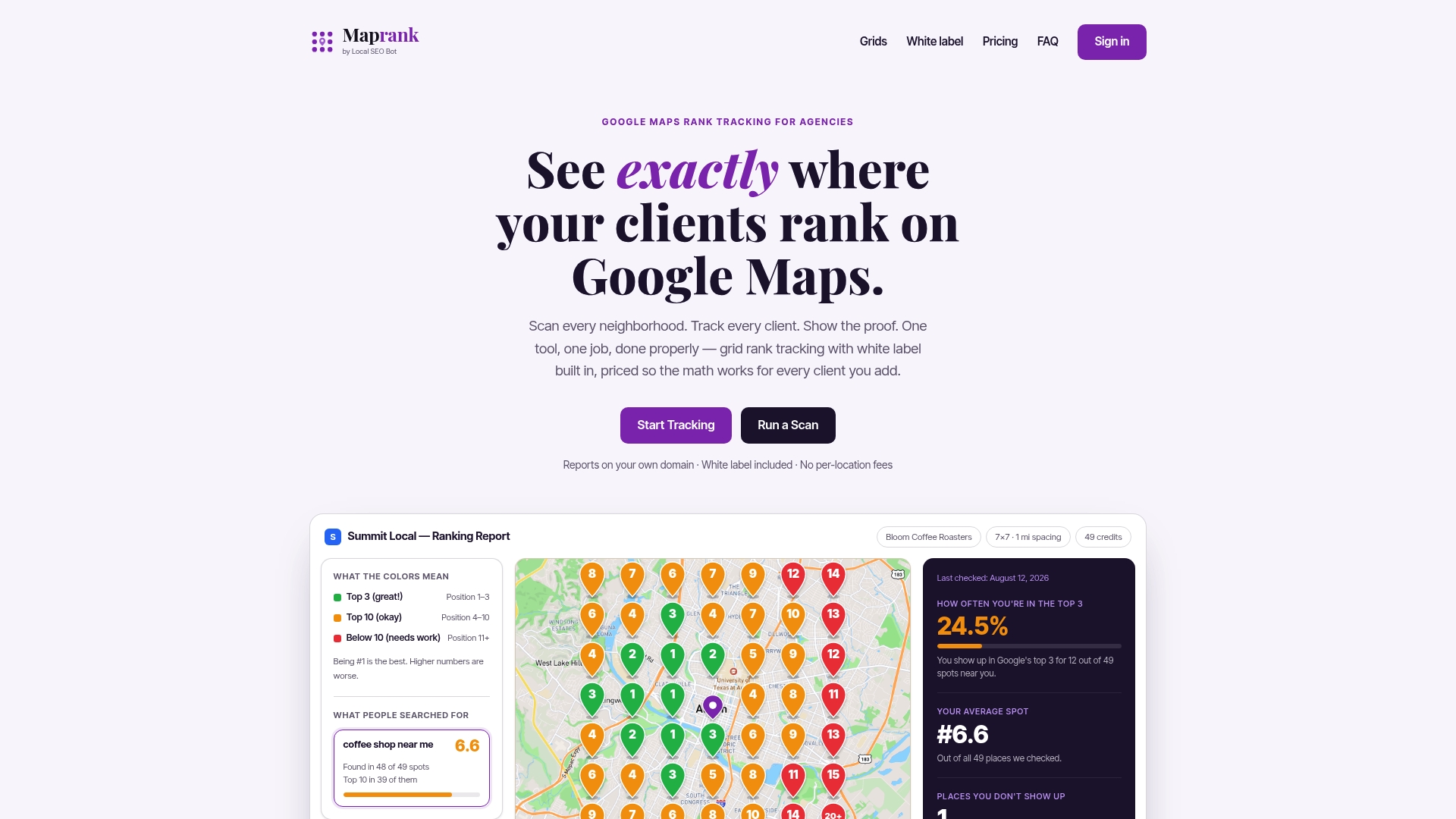
The smartest next step is the 14 to 30 day test outlined earlier in this guide: pull your busiest real client, run a realistic grid and scan cadence, and track exactly how many credits it consumes. Pair that with a genuinely useful resource for scheduling and reporting workflows, like the free tools from Served, and you’ll have a concrete cost projection before you commit a client budget anywhere. Check Maprank’s current plans and credit pricing and run the numbers against your own client roster today.