Map Pack Radius Shrank? 8-Step Vicinity Update Playbook for Local SEOs
Map Pack Radius Shrank? 8-Step Vicinity Update Playbook for Local SEOs
The Vicinity Update permanently increased proximity as the dominant local-pack signal, and that shift hasn’t reversed. Google confirmed the rollout ran November 30 through December 8, 2021, rebalancing local ranking factors, so distance to the searcher now outweighs prominence in most map-pack results. The immediate move: run geo-grid scans across your client’s service area to see exactly how far their visibility now reaches.
TL;DR:
- The Vicinity Update increased the importance of proximity in local search, shrinking the effective visibility radius for business listings, especially in urban areas.
- Keyword stuffing in business names lost its influence, as Google now relies more heavily on actual distance rather than text signals for ranking the map pack.
- Many businesses experienced a significant reduction in their prominence across wider regions, with nearby competitors gaining visibility in the tighter local areas.
- Accurate business information, especially address verification and removing keyword spam, has become crucial for local ranking recovery and sustained visibility.
- Deploying geo-grid scans regularly helps track actual proximity-driven changes, as single-location rank checks no longer reveal the true reach of local pack visibility.
Table of Contents
- What Was the Vicinity Update and When Did It Roll Out?
- What Changed: Proximity, Business Names, and the Map Pack
- Before and After: What the Ranking Data Actually Shows
- Which Industries and Listing Types Got Hit Hardest?
- Your Post-Vicinity GBP and Local SEO Checklist
- Should You Add Locations or Optimize Service Areas?
- How to Track Vicinity-Driven Rank Changes With Geo-Grid Scans
- What Agencies Should Change About Their Service Delivery
- See Exactly How Far Your Clients’ Listings Really Reach
- Sources
- FAQ
What Was the Vicinity Update and When Did It Roll Out?
Google confirmed the local search algorithm change rolled out between November 30 and December 8, 2021, describing it publicly as a rebalancing of local ranking factors rather than a single-signal tweak. The local SEO community started calling it the Vicinity Update almost immediately, because the dominant effect practitioners saw was proximity to the searcher swallowing other ranking inputs whole.
“Vicinity” in this context means the geographic tightness between a searcher’s location and a business listing. Before the update, a well-optimized, review-heavy, keyword-loaded listing could rank in the map pack for searches happening miles away. After it, that same listing often disappeared once the searcher moved a few blocks outside a much smaller radius. The map pack’s underlying geometry effectively shrank.
A few things are worth pinning down about the rollout itself.
- Google’s own statement confirmed the update as a rebalancing of local factors, not a full local algorithm rewrite.
- The change hit the three-pack and the local finder, not classic organic blue-link rankings.
- Reports of ranking volatility started surfacing in local SEO forums within days of the November 30 start date, well before Google acknowledged anything publicly.
- By March 2022, the community noticed Google had made corrections to some of the more extreme over-penalizations from the initial rollout, suggesting the first pass overcorrected in a few verticals.
That correction wave matters. It tells you the core proximity weighting stuck around, but Google tuned the edges. If a client’s listing recovered partially in early 2022 without any work on your end, that’s likely why.
What Changed: Proximity, Business Names, and the Map Pack
Two signals moved the most: how heavily Google weights distance, and how much a keyword-stuffed business name can compensate for not being close by.
Proximity weighting got dramatically more aggressive. Where a strong, well-optimized listing might previously surface across a five or ten-mile radius, many practitioners now see visibility windows closer to a mile or two in dense urban areas, sometimes tighter. Suburban and rural markets, with fewer competing listings, tend to retain a wider radius simply because there’s less density to compress against. The exact range varies by category and competition, but the direction is consistent: closer wins, and it wins by a bigger margin than it used to.
Keyword-stuffed Google Business Profile names lost most of their punch. A locksmith calling itself “ABC Locksmith Emergency 24/7 Best Cheap Locksmith Near Me” used to ride that name into rankings it had no business winning on proximity or relevance alone. The Vicinity Update reduced that advantage sharply, because proximity now does more of the ranking work than any text signal in the name field.
Statistic Callout: Agencies tracking the rollout documented map-pack “shrinkage” where listings that once dominated across an entire metro area saw their effective visible radius tighten dramatically, while nearby smaller competitors gained pack placements they’d never held before.
A few practical patterns fell out of this shift:
- Businesses centrally located in a city’s commercial core kept broader visibility simply because they’re geographically closer to more searchers.
- Businesses on the outskirts, even with stronger review counts and citation profiles, lost reach into downtown searches they used to win.
- Centroid bias got real: Google appears to weight the calculated center point of a service area or neighborhood more heavily, so businesses sitting near that centroid have a structural edge.
One clarification that trips people up: this was a local pack and Maps change. Organic blue-link rankings for the same queries mostly held steady, so a client complaining their map pack ranking cratered while their website traffic looked fine isn’t imagining a contradiction. It’s two separate ranking systems responding differently to the same update.
Before and After: What the Ranking Data Actually Shows
The clearest before/after signal agencies reported was straightforward: businesses that used to rank top-three across a wide radius started ranking top-three only within a much narrower band, while previously invisible nearby competitors climbed into view.
- Map-pack radius compression. Agency tracking documented cases where a business’s “winning zone” on a grid scan shrank from covering most of a metro area to covering only the neighborhoods immediately surrounding its physical address.
- New competitors appearing on grids. Smaller, previously buried listings started showing up in top-three positions for grid points near their own location, something that almost never happened before the update in competitive categories.
- Fewer one-box monopolies. Before Vicinity, one dominant listing could occupy the top spot across an entire grid map regardless of where the simulated searcher stood. That pattern largely disappeared; grids now show a patchwork of different winners depending on proximity, which is the visual signature of the update working as designed.
Statistic Callout: One agency’s before/after grid comparisons showed nearby smaller businesses gaining visible pack placements specifically in the zones closest to their address, while the previously dominant listing’s coverage contracted to a fraction of its former footprint.
Sample bias is the catch here. Agency case studies tend to feature dramatic before/after examples because those make better blog posts, not because every business in every market saw the same magnitude of change. A dentist in a low-competition suburb might have seen almost no visible shift.
The only way to know what actually happened in your market is to run your own grid comparison against historical data, if you have it, or a fresh baseline scan now against future scans. Don’t take a single case study as representative of what your client experienced. Pull your own numbers.
Which Industries and Listing Types Got Hit Hardest?
Legal services, home services (plumbers, HVAC, locksmiths), and dentistry showed some of the largest observed shifts, mostly because these categories had the heaviest concentration of keyword-stuffed names and single dominant listings gaming wide radii before the update.
Businesses that lost ground shared a pattern:
- Listings with keyword-stuffed names that leaned on text-matching to compensate for distance.
- Single-location businesses that had built dominance across an entire metro through aggressive citation and review volume, rather than genuine proximity to most searchers.
- Franchises or multi-location brands that had been treating one flagship location’s Google Business Profile as sufficient coverage for an entire region.
Businesses that gained ground looked different:
- Smaller, nearby businesses with accurate, non-stuffed names that simply hadn’t been able to compete against the wide-radius dominators before.
- Properly named brands sitting close to commercial or residential density centers, where more searches physically originate.
- Multi-location operators who already had distinct, well-optimized profiles for each site rather than relying on one hub location.
The nuance for multi-location brands: Vicinity didn’t punish having multiple locations. It punished relying on too few locations to cover too much geography. A brand with five accurately optimized locations across a metro came out ahead of a brand with one location trying to rank everywhere through sheer profile strength.
Your Post-Vicinity GBP and Local SEO Checklist
Recovery work here isn’t mysterious. It’s a matter of doing the fundamentals with more precision than you did before proximity became the dominant signal.
- Audit business name accuracy first. Pull every client’s Google Business Profile name and confirm it matches their real-world signage exactly, with no appended keywords or service descriptors. Removing keyword stuffing is one of the highest-leverage fixes available, because it’s a compliance issue Google actively polices, not just a ranking optimization.
- Clean up duplicate and unverified listings. Duplicate profiles fragment the proximity signal Google is trying to read. Search the business name and address combination in Maps directly to catch duplicates your rank tracker might miss.
- Verify hours and address precision. Small address inaccuracies matter more now, since proximity calculations depend on Google’s confidence in the pinned location.
- Shift review collection toward nearby customers specifically. Reviews from customers who searched and visited from close by reinforce the proximity signal more than distant one-off customers, so timing review requests at point-of-service, right after the job, beats a delayed email blast.
- Prune low-quality or distant citations. Citation directories listing outdated addresses or serving unrelated geographies dilute the location confidence Google assigns your listing.
- Prioritize local and community-specific citations. Chamber of commerce listings, neighborhood association directories, and local news mentions carry more proximity-relevant weight than generic national directories.
- Build neighborhood-specific landing pages where it’s genuine. A page that names the actual neighborhood, references real local landmarks, and uses LocalBusiness schema markup helps reinforce geographic relevance, but only build these for areas the business genuinely serves.
- Set a tracking cadence and keep a change log. Run scans on a consistent schedule and log every GBP edit, citation change, and review milestone against ranking movement so you can actually attribute cause and effect later.
Pro Tip: Don’t fix everything at once. Change the business name and clean duplicates first, wait two to three weeks for Google to reprocess, then layer in citation and content work. Stacking every fix in the same week makes it impossible to tell which change actually moved the needle.
Should You Add Locations or Optimize Service Areas?
Physical locations remain the most reliable lever for extending map-pack coverage after Vicinity. A service-area business setting on a single profile can only stretch so far before the proximity penalty makes distant rankings nearly impossible, no matter how strong the profile otherwise is.
The decision tree looks like this:
- Use service-area business settings when the business genuinely operates without a public storefront, like mobile repair or in-home services, and keep the declared radius realistic rather than aspirational.
- Open a new Google Business Profile at a real address when you need durable coverage in a neighborhood or suburb the flagship location can no longer reach.
- Build localized landing pages to support each verified location with unique content, not as a substitute for physical presence, since per-location optimization requires distinct citations and review funnels for each site to actually work.
Scaling checklist for each new location: separate citation set, a dedicated review request workflow tied to that location’s actual customers, and local content that reflects that neighborhood specifically rather than a templated copy of the flagship page.
How to Track Vicinity-Driven Rank Changes With Geo-Grid Scans
Single-point rank checks, the kind that just ask “where do I rank for this keyword,” miss almost everything Vicinity changed. A single check tells you your rank from one location. It tells you nothing about how far your visibility actually extends, which is precisely the thing that shrank.

Geo-grid scanning solves that by checking rankings across dozens of points spread over a map, revealing exactly where a listing wins and where it drops off. Grid-based tracking is now the standard recommendation for validating proximity-driven changes, because it’s the only method that visualizes the radius itself.
Track these KPIs on a recurring basis:
- Pack share by neighborhood, meaning what percentage of grid points in each named area show your client in the top three.
- Average rank distance, the typical distance from the business address at which rankings start dropping out of the pack.
- Percentage of tracked keywords that shifted specifically inside the new, tighter radius versus keywords that held steady further out.
Run a full grid scan before making any changes, then rescan every two to four weeks to catch movement without drowning in noise from daily fluctuation. Every before/after audit should record the scan date, grid size, and radius so you can compare apples to apples months later.
Pro Tip: Save your baseline grid scan before touching anything on a new client’s account. Without it, you have no way to prove the Vicinity-related recovery work you’re billing for actually did anything. Tools built specifically for this, including Maprank’s customizable scan grids and white-label reporting, let agencies document this kind of shift in a format clients can actually read.
What Agencies Should Change About Their Service Delivery
Vicinity turned local SEO into a neighborhood-first discipline, and most service delivery models haven’t caught up. Treating a metro-wide client as one optimization target is outdated; each location, or each service neighborhood for a single-location business, now needs its own goals and its own reporting line.
That means building per-location SLAs into contracts and giving clients reporting broken out by neighborhood rather than one blended metro number that hides where they’re actually winning or losing ground. For agencies weighing where to put budget between core SEO fundamentals and newer AI-driven visibility work, understanding how local and technical SEO priorities stack against AI-era search is worth factoring into that planning.
One more thing: the temptation to chase proximity by gaming the business name field never fully goes away. Resist it. Google’s guidelines on accurate naming aren’t going anywhere, and clients who get caught stuffing keywords into their profile name risk suspension, which erases the very visibility you’re trying to protect.
— Local
See Exactly How Far Your Clients’ Listings Really Reach
Most agencies are still reporting local rankings the way they did before 2021, one keyword, one location, no sense of radius. Maprank was built for exactly the gap the Vicinity Update created: it runs customizable scan grids that show precisely where a client’s map-pack visibility starts and stops, without connecting to their Google account.
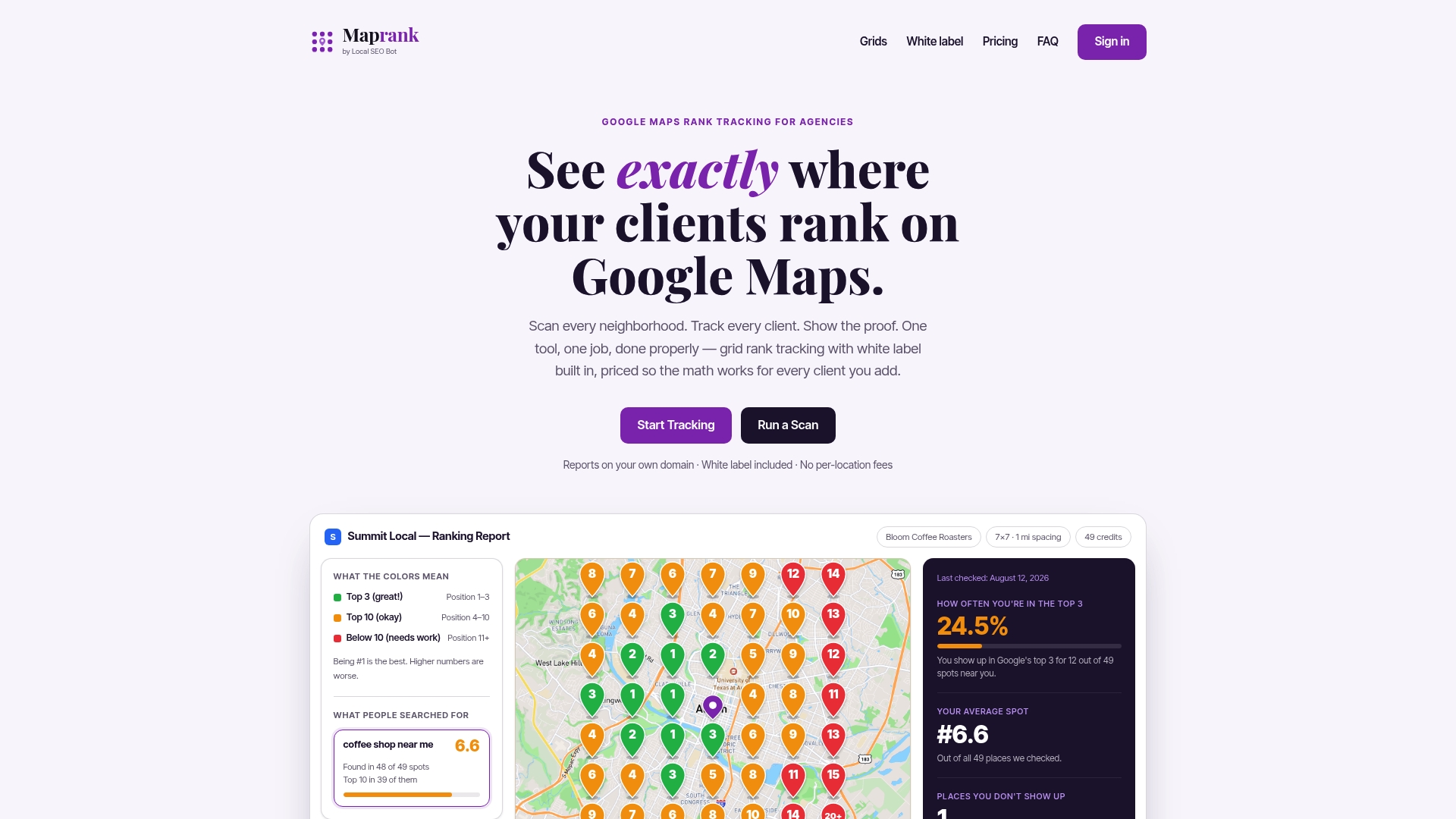
Every plan includes unlimited businesses and white-label reporting on your own domain, so instead of telling a client “your rankings improved,” you can hand them a branded map showing exactly which neighborhoods they now win and which ones still need work. Pricing runs on straightforward credit bundles rather than per-location fees, starting at Maprank Solo for $19 a month, scaling up through Agency and Pro tiers as your client roster grows. If you want to see what a single scan looks like before committing to a plan, the rank tracker product page walks through how the grid scans work.
Sources
- The Vicinity Update: What You Need to Know About Google’s Largest Local Algorithm Update in 5 Years - Sterling Sky Inc
- Google Vicinity Update: Definition, Impact & Local SEO Guide 2026 | theStacc Glossary
- The New Google Vicinity Update - Shoreline Digital Marketing
- Google’s Vicinity Update: Largest Local SEO Update in Years | Wit Digital | Wit Delivers
FAQ
Is the Vicinity Update Still Affecting Rankings Today?
Yes. The proximity weighting the update introduced in December 2021 has remained the dominant local-pack factor since, with only minor corrections in early 2022 smoothing out some over-penalization. It’s not a temporary fluctuation. It’s the current baseline for how Google ranks local results.
How Do I Know if a Client Was Hit by the Vicinity Update Specifically?
Run a geo-grid scan and look for a shrunk visibility radius compared to older single-point rank data, especially if the client’s business name previously relied on keyword stuffing. A tool like Maprank’s grid scanning can visualize that radius directly rather than guessing from anecdotal ranking drops.
What Are the Latest Google Local Search Updates Beyond Vicinity?
Google continues to make smaller, unannounced adjustments to local ranking factors throughout the year, and most don’t get an official name or confirmation the way Vicinity did. The most reliable way to catch these is consistent grid tracking over time rather than waiting for community speculation to catch up.
What Are the Latest Best Practices in Local SEO After Vicinity?
Current best practice centers on accurate, non-stuffed business names, nearby review collection, local and community-specific citations, and per-location optimization for any multi-site brand. Neighborhood-level content and schema markup support these fundamentals but don’t replace them.
Does the Vicinity Update Affect Organic Rankings Too?
No, the update targeted the local pack and Maps results specifically, not standard organic blue-link rankings. A business can see map-pack visibility shrink while its organic search traffic for the same keywords stays largely unaffected.