Agencies With 5–40 Clients: White Label Map Reports That Keep Clients
Agencies With 5–40 Clients: White Label Map Reports That Keep Clients

The fastest way for an agency to deliver trustworthy branded map reporting is an agency focused white label rank tracking tool with grid scans and custom domain reports. Among the options built for this job, Maprank aligns closely with what agencies need. Run the checklist below against any tool, then request a branded sample report before committing.
TL;DR:
- Grid scan-based rank tracking provides detailed neighborhood insights that single-point checks cannot reveal across large service areas.
- Maprank supports full white labeling, unlimited businesses, and credit-based pricing models that avoid automatic cost increases as an agency grows.
- Proper configuration of branding, scheduling, and narrative is crucial to produce client reports that are clear, actionable, and enhance retention.
- Reports should focus on a few key metrics and visual maps to communicate ranking changes effectively during client meetings.
- Compliance with Google Maps attribution policies is essential when using map data in reports to maintain trust and avoid violations.
Table of Contents
- What to check before you pick a white label map reporting tool
- How white label map reports are produced
- How Maprank satisfies the agency checklist
- Step by step: build a branded map report clients will act on
- How to present branded map reports to clients to improve retention
- Why branded map reports matter for retention
- How to get started with Maprank
- FAQ
- Sources
What to check before you pick a white label map reporting tool
Not every reporting tool treats agencies the same way, and the gaps show up fastest in branding and pricing. Before you sign up, work through these points in order.
- Branding depth: confirm the tool supports your logo, color palette, a custom domain, branded emails, and a client portal that never shows the vendor’s name.
- Pricing shape: find out whether costs scale per client, per location, or through a credit or scan model, since the difference compounds as you grow from 5 clients to 40.
- Geo tracking method: ask whether rankings come from grid scans across a service area or single point checks at one address, since density affects how much neighborhood detail you get.
- Integrations: check for Google Business Profile connections, Maps Platform API access, and export options your team already relies on.
- Report sharing: look for scheduled PDFs, embeddable dashboards, and share links that sit on your own domain rather than the vendor’s.
- Client experience: verify automated scheduling, time zone handling for multi-market clients, and a mobile friendly report view.
- Compliance: make sure the vendor’s attribution and data handling match Google Maps Platform’s terms, which require displaying all attribution Google provides and following its trademark guidance.
Pro Tip: Ask any vendor for a live branded sample report before you buy. A polished sales deck tells you nothing about how the client portal actually looks on your domain.
How white label map reports are produced
A branded map report starts with raw position data and ends as a document your client can open without ever seeing the vendor’s name. Understanding the pipeline helps you judge where a tool cuts corners.
- Data sources: grid or geo-raster scans capture ranking position across many points in a service area, while Google Business Profile metrics add impressions and click data on top.
- Pipeline: scheduled scans feed into normalization, then visualization, then export as a PDF, a share link, or an embedded widget that can incorporate Google Business Profile reviews for trades to enhance local insights.
- Grid scanning: checking dozens of points across a neighborhood reveals ranking differences a single address check misses entirely, which matters for any business competing across a wide service area.
- Attribution rules: Google Maps Platform’s terms require every report that uses map data to display the attribution Google provides, and the Maps Additional Terms of Service prohibit redistributing map data or building a substitute mapping service from it.
- Embedding versus hosting: an embedded dashboard keeps you dependent on the vendor’s infrastructure, while a hosted, white labeled report gives you full control over branding and client experience.
Grid based tracking reveals position differences across a service area that a single geocoded check cannot surface, which is why it has become the standard method for agencies reporting on multi-location or service-area businesses.
How Maprank satisfies the agency checklist
Maprank’s own claims map directly onto the checklist above, which makes it worth a closer look for agencies evaluating where to land.
- White labeling: reports and the client portal run on the agency’s own domain across plans, with no Maprank branding visible to the end client, as described on the local SEO rank tracker page.
- Grid rank tracking: customizable scan grids let agencies choose how tight or wide the coverage area is, without requiring Google account connections, which removes a common access barrier when onboarding new clients.
- Pricing shape: plans use credit based scan bundles rather than per-location fees, so adding a new client account does not automatically increase the bill.
- Unlimited businesses: plans allow unlimited businesses, which matters for agencies managing a growing client roster rather than a handful of accounts.
- Workflow: scheduled scans populate a client portal where reports can be exported as PDFs or shared through a branded link, matching common agency delivery practices.
White labeling and predictable per-scan pricing, rather than one more analytics chart, are usually what decide whether an agency keeps a reporting tool past the first renewal.
These are Maprank’s own claims about its product, and agencies should confirm current plan details on the Maprank site before standardizing a workflow around them.
Step by step: build a branded map report clients will act on
A report only earns its place in a client meeting if it is easy to scan and clearly tied to work your team did. Follow this sequence each month.
- Set grid size and density based on the client’s service area, balancing coverage against the scan credits each grid consumes.
- Pick a cadence and template, typically monthly, covering rank shifts, a map visual, Google Business Profile metrics, review highlights, and a short recommendation.
- Configure branding once: custom domain, your logo in the header and footer, and scheduled email delivery so reports arrive without manual work.
- Write the narrative last, after the data populates: call out where rankings improved, explain any drop in plain language, and recommend one next step.
- Run a QA pass before sending, checking that attribution displays correctly and that every chart matches the data behind it.
Pro Tip: Keep the first page to three numbers and one map. Clients remember a single annotated neighborhood map longer than a ten-row ranking table.
How to present branded map reports to clients to improve retention
The report itself only does half the job. How you present it determines whether a client renews or starts shopping for a replacement agency.
Open the conversation with the map, not the spreadsheet. A visual showing where a business climbed into the map pack across specific neighborhoods gives a client something concrete to point to, far more than a column of position numbers. Lead with two or three metrics that tie directly to what you worked on that month, rather than walking through every data point the tool generated.
When rankings drop in part of the service area, name the cause in plain terms before the client has a chance to ask. A short explanation paired with a specific next step reads as expertise; silence on a dip reads as something being hidden. Close every review with one clear recommendation, whether that is adding service pages for an underperforming neighborhood or requesting more reviews in a specific zip code.
Agencies that standardize this format across every client account build a predictable rhythm that clients come to expect, which itself becomes a quiet reason not to cancel. A consistent branded report, delivered on schedule with a short narrative attached, does more for retention than any single ranking improvement.

Why branded map reports matter for retention

Local business owners rarely understand ranking algorithms, but they understand a map with their business highlighted in their own neighborhood. That visual does more to justify a monthly retainer than another page of metrics ever will.
The mistake I see most often is agencies dumping every available chart into a report instead of choosing two or three numbers that tell a story. Before rolling a new report format out across your whole client list, test it with one account, watch how they react in the next call, and adjust before you scale it.
— Local
How to get started with Maprank
If you want to see whether branded map reporting changes how clients respond to your monthly check-ins, the lowest-risk move is a direct test: run a scan on one client’s business and ask for the branded sample report before you touch anything else in your workflow.
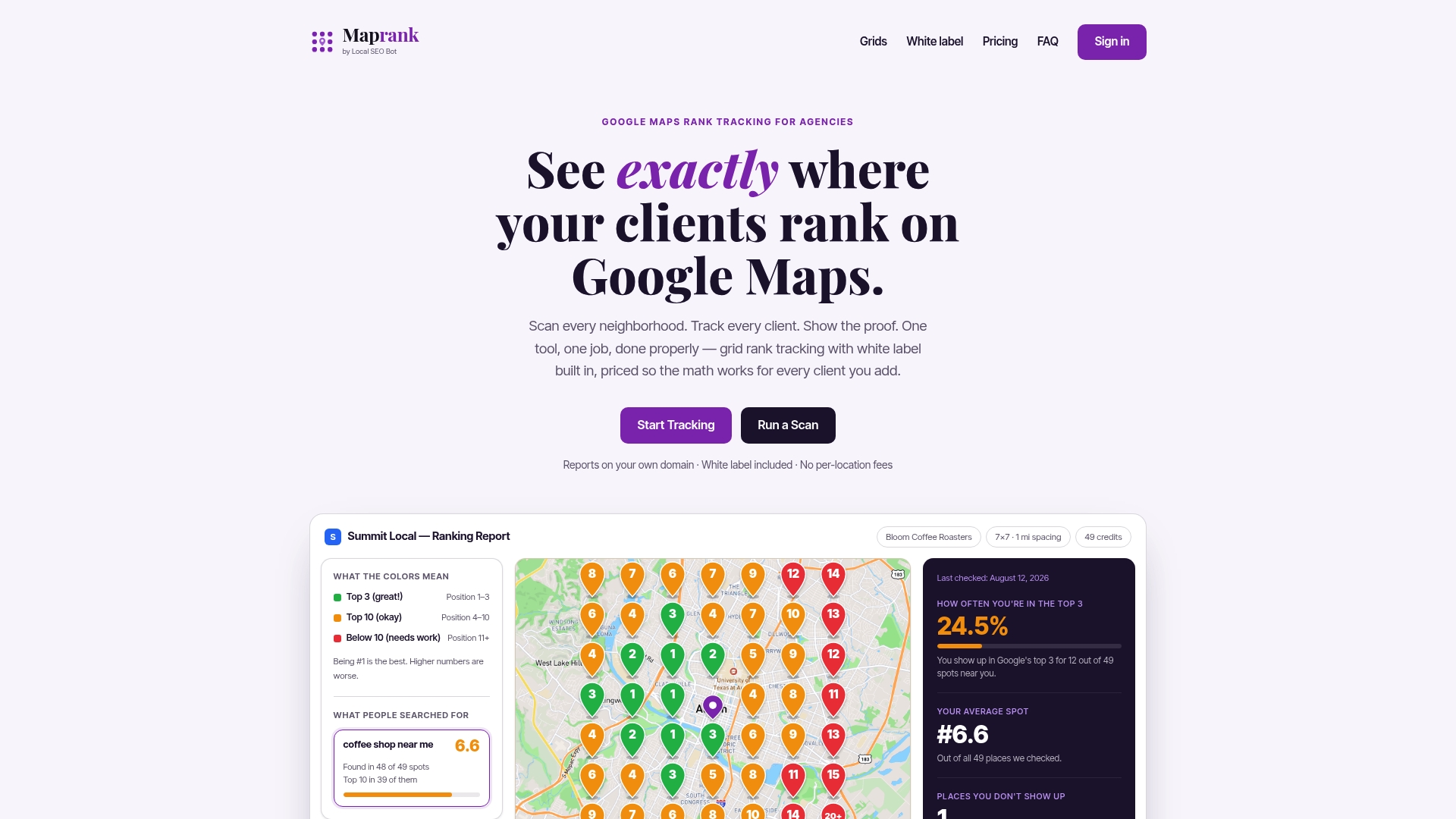
- Request a demo or run a sample grid scan through Maprank and review the branded report exactly as your client would see it.
- Check the credit based pricing shape across Maprank Solo, Maprank Agency, Maprank Pro, and Maprank Scale plans, all of which include unlimited businesses and white labeling.
- Pilot the workflow with a single client first, then measure how much time it saves your team and how clearly the client understands the results before rolling it out further.
Compare the grid tracking approach against other methods on the Google Maps rank tracker page, or see how it stacks up against other tools in the 2026 rankings roundup.
FAQ
What is the best software for mapping?
The right choice depends on the job: general mapping needs differ from local rank tracking for agencies. For agencies specifically reporting on Google Maps visibility, a grid-based rank tracker built for white labeling, such as Maprank, fits the job better than general-purpose mapping software.
What is a white label report?
A white label report is a document or dashboard built by one company’s software but branded entirely with another company’s logo, colors, and domain. Agencies use white label reports so clients see the agency’s own brand throughout, with no sign of the underlying tool.
What is a MAP in e-commerce?
In e-commerce, MAP stands for minimum advertised price, a manufacturer policy that sets the lowest price at which retailers can advertise a product. This is unrelated to map based rank tracking or geographic reporting tools covered in this guide.
What is a famous map company?
Google Maps is the most widely recognized mapping platform, and its data underlies many of the rank tracking and reporting tools agencies use for local SEO. Agencies building on top of this data must follow Google Maps Platform’s terms, including its attribution requirements.
Sources
- Google Maps Platform Terms Of Service | Google Cloud
- Google Maps Additional Terms of Service – Google