Operations Playbook: Multi Location Local SEO for Agencies
Operations Playbook: Multi Location Local SEO for Agencies
Treat every physical location as its own local entity, but run the whole program from one centralized system. That means unique location pages, verified Google Business Profiles for each address, and geo-grid rank tracking to see how you actually perform block by block. Scaling past a handful of locations requires a master data repository, templated launch checklists, and unique local signals for every single branch, as detailed in AI for SEO: Content at the Pace Rankings Need.
TL;DR:
- Building unique, detailed location pages with accurate local facts, reviews, and structured data is essential to avoid cannibalization and improve local rankings.
- Maintaining consistent and verified Google Business Profiles, along with regular audits of categories, attributes, and local signals, is critical for visibility and AI relevance.
- Tracking rankings at the neighborhood level with geo-grid scans reveals actual coverage gaps and helps connect visibility to real-world results like calls and visits.
- Scaling multi-location SEO requires templates, a master data repository, and automated pipelines to ensure uniformity and efficiency across hundreds of locations.
- Coordinating organic SEO with paid local campaigns amplifies results, especially when local signals influence both rankings and ad performance.
Table of Contents
- What Is Multi Location Local SEO?
- Building Location Pages That Actually Rank
- How Do You Manage Google Business Profiles at Scale?
- Why Review Velocity Matters More Than Star Rating
- Keeping NAP Consistent Across Dozens of Citations
- Local Backlinks and Community Signals That Move the Needle
- Why Geo-Grid Rank Tracking Changes What You See
- Building a Launch Checklist That Scales to Hundreds of Locations
- How AI Answer Engines Are Reshaping Local Visibility
- Managing SEO for Service Areas Without a Storefront
- Doing Keyword Research That Respects Local Differences
- Coordinating Local SEO With Paid Local Ads
- Measuring Success Beyond the Rank Report
- What Agencies Learn Running These Programs at Scale
- Maprank: Built for Agencies Tracking Clients Across Many Locations
- Primary Sources and Tool Links
- Sources
- FAQ
What Is Multi Location Local SEO?
Local search optimization for a single storefront is straightforward. Multi location local SEO is a different discipline entirely, because Google and AI answer engines now evaluate each address as a separate entity competing in its own micro market. A five-location dental group isn’t running one local SEO campaign. It is running five, plus a governance layer that keeps them all consistent.
Google has said publicly that local results depend on relevance, distance, and prominence, and that a complete Business Profile raises the odds of appearing in local results at all. In 2026, that same logic extends to AI-driven answer engines pulling from entity signals: a complete, verified profile with consistent schema and sameAs links back to your Google Business Profile helps large language models match a query like “closest urgent care in Riverside” to the correct physical branch, not just the brand as a whole.
The evidence Google and AI systems weigh looks like this:
- Google Business Profile completeness, including categories, attributes, hours, and services
- Citation consistency across data aggregators and directories
- Review volume, recency, and sentiment at the individual location level
- Backlinks and local mentions pointing to a specific address, not just the homepage
- Location-specific photos, geo-coordinates, and structured data
The practical implication: prioritize location-level work over brand-level polish. A gorgeous homepage does nothing for the Tulsa branch if its GBP is unclaimed and its page is a copy-paste template.
Building Location Pages That Actually Rank
Thin, duplicated location pages are the single most common reason multi-location brands stall out. Search Engine Journal’s guide to local SEO for multiple locations is blunt about it: each physical location needs a dedicated, indexable page with unique local facts, not a mail-merge template with the city name swapped out.
Build each page around these elements:
- Exact NAP (name, address, phone) matching the GBP character for character
- Embedded map with accurate geo-coordinates
- Real hours, including holiday exceptions specific to that branch
- Services actually offered at that location, not the full brand menu
- Local team photos and staff names, not stock imagery
- Location-specific reviews pulled live, not brand-wide testimonials
- A short FAQ addressing questions unique to that neighborhood or market
Use a URL structure like /locations/city-name/ rather than a query string or a subdomain per branch. It’s cleaner for crawling and easier to manage internal links against. Cross-link nearby locations sparingly and only where genuinely useful, since two pages competing for “dentist near downtown” cannibalizes both.
The fix for cannibalization isn’t fewer pages. It’s sharper differentiation. Template the skeleton (layout, schema, navigation) but require unique input in the team section, the reviews feed, and the local FAQ block for every location. Search Engine Journal notes that agencies scaling this well pull live regional data (review feeds, staff rosters) into the template automatically rather than hand-writing each page from scratch.
Pro Tip: Write one paragraph per location page that could not be copied to any other branch without becoming factually wrong. If you can swap two pages’ unique sections and nobody notices, they aren’t unique yet.
How Do You Manage Google Business Profiles at Scale?
Verification is where most multi-location programs bleed time. Bulk verification through a single Business Account, rather than location-by-location claims, keeps ownership centralized and prevents the classic problem of a regional manager claiming a listing on a personal Google account that the marketing team can never access again.
Once profiles are verified, the audit work never really stops. Fields that need regular review:
- Primary and secondary categories, since Google occasionally auto-suggests incorrect ones
- Attributes (wheelchair access, outdoor seating, appointment-only) that change with renovations or policy shifts
- Service areas versus storefront address settings, especially for hybrid businesses
- Photos, since stale or brand-only imagery underperforms real local photos
- Q&A sections, which competitors or the public can post to unless monitored
Set a quarterly audit cadence at minimum, monthly if you’re opening or closing locations frequently. Assign a single owner per region who can make edits, but keep publish permissions centralized so no field manager accidentally changes a category and tanks visibility for a week before anyone notices.
Pro Tip: Screenshot every GBP’s category and attribute settings quarterly and store them in your master data repo. When a listing suddenly drops in visibility, the first move is comparing today’s settings against last quarter’s screenshot, not guessing.
Why Review Velocity Matters More Than Star Rating
A 4.9 average built on twelve reviews from three years ago tells Google, and increasingly AI answer engines, that a location is dormant. Freshness and volume both function as trust signals, and reviews are rising in importance as a signal that both traditional ranking algorithms and AI systems weigh when deciding which branch to recommend.
Build the acquisition system location by location:
- Add a QR code to receipts or checkout screens that opens the specific location’s review link, not the brand’s generic one
- Trigger a text or email review request within a few hours of the transaction, while the experience is fresh
- Set an internal target for new reviews per location per month, and treat a flatlining location as a flag for the whole team
- Centralize monitoring in one dashboard so a two-star review in Tucson doesn’t sit unanswered for two weeks because nobody on the corporate team saw it
- Respond to every review with a personalized note that references specifics from the review itself, not a copy-paste script
Templated responses are fine as a starting draft. Personalizing at least one sentence per response, referencing the customer’s actual comment, is what separates a location that looks cared for from one that looks automated.
Keeping NAP Consistent Across Dozens of Citations
Name, address, and phone number inconsistency is the quiet killer of multi-location visibility. It’s rarely dramatic. It’s a suite number dropped from one directory, a “St.” abbreviated as “Street” on another, and a phone number that changed two years ago but never got updated on a data aggregator.
The fix starts with a canonical record for every location, stored in one master spreadsheet or database that nobody edits without going through a single owner. Consistency requires centralizing canonical records and enforcing character-for-character formatting for every address and business-name field, because “Suite 200” and “Ste. 200” register as two different businesses to some citation engines.
From there:
- Push canonical data to major data aggregators on a scheduled cycle, not just at launch
- Audit top citation sources quarterly using a citation tool or manual spot-checks
- Search for duplicate listings under old addresses or former business names and file suppression or merge requests
- Treat each location’s citation profile as its own asset. A five-year-old location with 40 clean citations will always outperform a new one with three
Duplicate listings are especially common after a rebrand, a relocation, or a franchise ownership change. They split review counts and confuse both users and algorithms about which listing is authoritative.
Local Backlinks and Community Signals That Move the Needle
A backlink from the Sacramento Chamber of Commerce to your Sacramento location page does more for that specific branch than ten generic guest posts ever will. Local links function as prominence signals at the address level, not just the domain level.
The links worth pursuing:
- Chamber of commerce and local business association directories
- Local news coverage of a store opening, a community event, or a sponsorship
- Sponsorship pages for youth sports leagues, charity runs, or school fundraisers tied to a specific branch
- Event pages where your location hosted or co-hosted something, with a link back to that location’s page specifically
Scaling this without it feeling hollow means empowering field teams. A regional manager who actually sponsors the local 5K can secure a real link that a remote marketing team never could. Measure impact per location by tracking that branch’s local pack position and page authority before and after the link lands, not by watching domain-wide metrics that dilute the signal.
Why Geo-Grid Rank Tracking Changes What You See
A single “average rank” number for a ten-location brand is nearly useless. It masks the fact that one branch dominates its neighborhood while another is invisible six blocks from its own front door. Rankings vary significantly by neighborhood, and standard city-level or single-point tracking obscures exactly where that variation happens.
Geo-grid scanning solves this by checking rankings across a grid of points surrounding each location rather than one central coordinate. Setting it up in practice:
- Define a grid size proportional to the service radius. A dense urban location might need a tight quarter-mile grid; a suburban branch with a ten-mile draw area needs wider spacing.
- Include both primary category terms (“plumber”) and “near me” style queries in the scan set, since they often surface different competitors.
- Run scans on a consistent cadence, weekly at minimum for competitive markets, so ranking shifts show up before a client asks why leads dropped.
- Track map pack coverage as a percentage of grid points where the location appears in the top three, not just whether it ranks first anywhere at all.
- Layer attribution on top: unique tracking phone numbers per location, UTM-tagged GBP website links, and call tracking tied to the specific listing.
Building the attribution chain that connects rank to revenue
Visibility without attribution is just a vanity dashboard. Pair grid coverage data with a unique phone number per location (routed through call tracking) and UTM parameters on every GBP website field, and you can build a dashboard that shows, location by location, how grid coverage correlates with calls and website clicks. A Google Maps Rank Tracker built around grid scanning makes this comparison visual instead of theoretical, since a coverage map next to a call-volume chart tells the story faster than a spreadsheet of rank numbers ever will.
Building a Launch Checklist That Scales to Hundreds of Locations
Manual, location-by-location SEO setup collapses once you pass roughly ten branches. Multi-location programs need to run as an operational system, built on templates, a canonical data repository, and a repeatable launch sequence rather than one-off effort per address.
Three assets make this work:
- A location page template with hard-coded required fields (team photo, local FAQ, live review feed) that can’t be published incomplete
- A GBP launch checklist covering verification, category selection, attributes, initial photo upload, and service area confirmation
- A citation pipeline that automatically pushes new location data to major aggregators the day a listing goes live
Assign clear roles: brand-level teams own templates, schema standards, and the master data repo; field or regional managers own local photo uploads, review responses, and community outreach, all published through a permissioned system rather than direct GBP access.
The most common recovery scenario is a rushed launch. A store opens, someone claims the GBP quickly to get it live, and the location page gets built later with generic copy. Fix it by running a 90-day audit on every new location against the same checklist used at launch, and add a standing quarterly audit for the full portfolio so drift gets caught early.
Pro Tip: Keep the launch checklist as a living document a field manager can complete without SEO expertise. If it requires a specialist to fill out, it won’t survive the tenth location, let alone the hundredth.
How AI Answer Engines Are Reshaping Local Visibility
AI systems and answer engines increasingly treat GBPs and location pages as entity anchors rather than just web pages to crawl. Search Engine Journal’s research on AI visibility points to distinct, verifiable local facts as the deciding factor when an AI model has to choose which specific branch to recommend for a query.
What that means operationally:
- LocalBusiness schema per page, with a sameAs property pointing to the verified GBP, gives AI systems a clean signal linking the two records together
- Micro-content like “opened in 2019,” “the only location with a drive-through,” or “specializes in same-day appointments” gives AI models something concrete to quote
- GBP Q&A sections answered thoroughly, in your own words, become a direct source AI systems pull from
- Track brand and location mentions in AI chat outputs where possible, alongside GBP engagement metrics like Q&A views and direction requests, as early indicators of AI-driven discovery
Managing SEO for Service Areas Without a Storefront
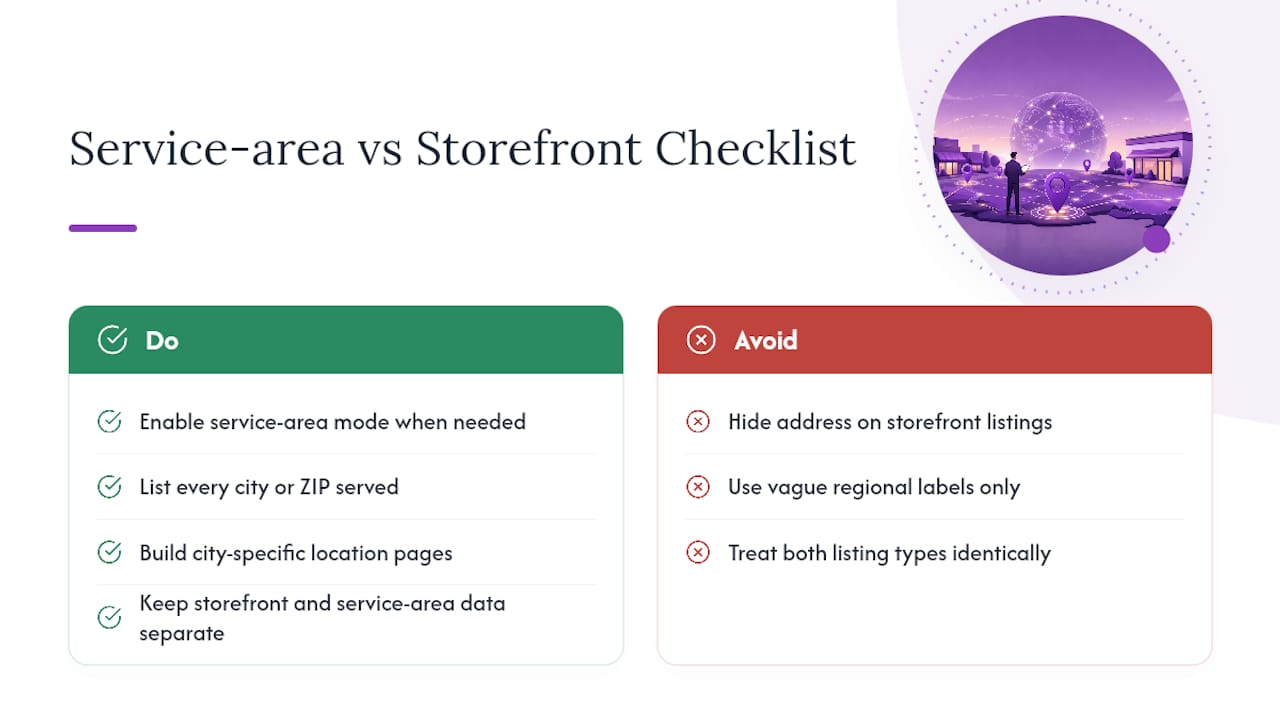
Not every location fits the tidy storefront model. Plumbers, mobile groomers, and home cleaning franchises often serve a radius rather than sit behind a fixed address, and Google Business Profile treats that differently. A service-area business can hide its address on the profile entirely, which changes how it competes in the map pack compared to a visible storefront.
The setup matters. Selecting service-area mode correctly and listing every city or zip code actually served, rather than a vague regional label, gives Google enough signal to place the listing accurately. A hidden-address GBP behaves differently in ranking than a storefront’s profile, and treating the two identically is a common setup mistake.
Location pages still matter here, arguably more. Without a physical address to anchor local relevance, a service-area business leans harder on location-specific landing pages covering each city or neighborhood it serves, each with locally relevant content, not just a service area listed in a footer.
Hybrid models, a retail chain that also offers regional delivery, or a clinic with a home-visit program, need both systems running in parallel: standard storefront optimization for the physical address, and separate service-area content for the surrounding region it also covers. Keep these clearly separated in your master data repo so a field team member doesn’t accidentally set a storefront listing to hide its address, or vice versa.
Doing Keyword Research That Respects Local Differences
A national keyword list applied uniformly across fifty locations misses how people actually search in different markets. Denver residents might search “ski gear repair” while a Miami location in the same retail chain sees zero volume for that term and heavy volume for something entirely different.
Start with brand-wide core terms, then layer in location-specific research for each market. Local search behavior often includes neighborhood names, transit references (“near the Metro stop”), and colloquial business terms that vary by region. A location page for a Chicago branch might reasonably target “near the Loop,” while a Phoenix branch never would.
Content strategy at scale means building a shared content framework, service descriptions, core value propositions, brand voice, while leaving explicit gaps for local insertion: local landmarks, regional terminology, seasonal considerations specific to that climate or market. A landscaping company’s Minneapolis location page should mention snow removal; its Phoenix page never needs to.
Avoid the trap of writing fifty nearly identical blog posts targeting “[service] in [city]” with no substantive local difference between them. Google’s systems and AI answer engines increasingly recognize this pattern, and it does little for rankings while creating real cannibalization risk between nearby locations.
Coordinating Local SEO With Paid Local Ads
Organic and paid local campaigns work better together than either does alone, but only when they’re actually coordinated rather than run by separate teams pulling separate budgets.
Google Local Services Ads and geo-targeted paid search both pull from the same GBP data that organic local rankings depend on. A profile with strong categories, complete attributes, and fresh reviews performs better in Local Services Ads auctions too, which means the organic hygiene work described earlier compounds into paid performance as well.
Use paid campaigns to test which local keyword variations actually convert before committing organic content resources to them. If a geo-targeted ad campaign for “emergency HVAC repair” in a specific zip code converts well, that’s a strong signal to build organic content around that exact phrasing for that location.
Budget allocation should follow the map pack data, not guesswork. A location with weak organic visibility in its geo-grid scan is a reasonable candidate for heavier paid support while the organic work catches up, rather than spreading ad spend evenly across locations regardless of their organic standing.
Measuring Success Beyond the Rank Report
Rankings are a leading indicator, not the outcome anyone actually cares about. The metrics that matter to a business owner or a client paying for multi-location SEO connect visibility to revenue.
Track direction requests and phone calls from each GBP as a baseline engagement signal, since both correlate closely with foot traffic even when exact attribution is imperfect. Layer in call tracking with unique numbers per location, so a spike in calls can be traced to a specific listing rather than the brand overall. Website clicks from GBP, tagged with UTMs, feed into conversion tracking on the location page itself, whether that’s a form fill, an appointment booking, or a click to call.
For businesses with physical foot traffic, some retailers and multi-location brands use point-of-sale data or loyalty program check-ins cross-referenced against ranking improvements to estimate lift. It won’t be perfectly clean attribution, but a location that jumps from three to twelve map pack points of coverage and sees a corresponding uptick in walk-in traffic over the same weeks is a pattern worth reporting to stakeholders, even without a controlled experiment behind it.
What Agencies Learn Running These Programs at Scale
Triage first. Fix the five locations with the biggest gap between potential and current visibility before touching the ones already performing well. When reporting to operations teams, tie every recommendation to a number they already track, like calls or foot traffic, rather than raw ranking positions they don’t feel day to day.
— Local
Maprank: Built for Agencies Tracking Clients Across Many Locations
Maprank is a way to put geo-grid tracking into action without per-location fees that make most rank trackers painful to scale. Plans include unlimited businesses, so an agency managing multiple branches or clients pays for scan credits and grid size, not a per-listing tax.
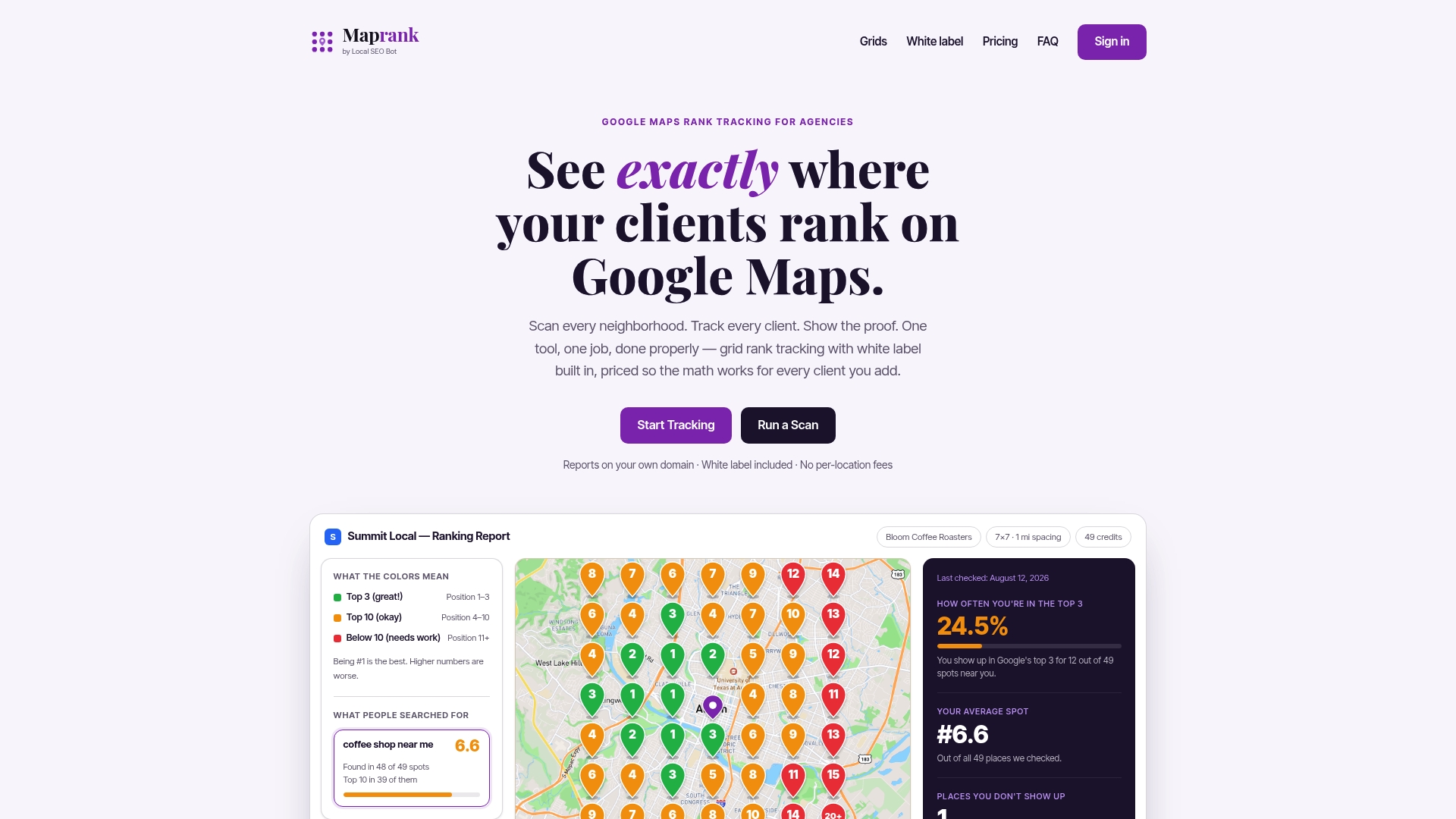
The customizable scan grids let you match tracking density to how each location competes, with options for dense urban markets and wider ones for suburban areas, and white label reporting means every report can appear on your own domain. Showing clients precise, branded data on where they rank block by block supports strong renewal conversations. If you’re evaluating options for Google Maps rank tracking across a multi-location portfolio, run an initial grid scan on your highest-priority client’s locations and see where the visibility gaps actually sit before your next review call.
Primary Sources and Tool Links
This article draws on Google’s own guidance on local ranking factors, Search Engine Journal’s multi-location SEO guide, and Backlinko’s multi-location scaling guidance. Explore tracking tools at Maprank.
Sources
- Google Business Profile help: How Search ranks local results
- The Complete Guide To Local SEO For Multiple Locations
- Multi-Location SEO: How to Scale Without the Chaos
- SEO for multiple locations: How to build a local search architecture that ranks every location
FAQ
How Do You Do Local SEO for Multiple Locations?
Build a unique, indexable page and a fully verified Google Business Profile for every address, keep NAP data identical across all citations, and track rankings with neighborhood-level geo-grid scans rather than one brand-wide average.
Is SEO Dead Now That AI Answer Engines Exist?
No. AI systems still rely on the same underlying signals, complete GBPs, consistent citations, structured data, and reviews, to decide which specific location to recommend, so the fundamentals of local search optimization matter as much as ever.
What Is the 80/20 Rule in Multi-Location SEO?
Applied to multi-location programs, it means a small share of locations, often the ones with incomplete GBPs or thin pages, account for most of the visibility gap, so triaging those first delivers the fastest overall lift.
How Much Should You Pay for Local SEO Across Multiple Locations?
Costs vary widely by location count, market competitiveness, and whether work is agency-managed or in-house, but tools like geo-grid rank trackers typically scale by scan volume and grid size rather than a flat per-location fee, which keeps larger portfolios more predictable to budget.
Why Do Geo-Grid Scans Matter More Than a Single Rank Check?
A single rank check shows one point on the map, while a geo-grid scan reveals how visibility shifts across an entire neighborhood, exposing coverage gaps a city-level average would completely hide.