Local Businesses: Fix GBP and Category to Prove Near Me Rank Gains
Local Businesses: Fix GBP and Category to Prove Near Me Rank Gains
To rank for “near me” searches, fix your Google Business Profile and primary category first, then build steady review and citation signals. Distance to the searcher is largely fixed and the least controllable, but relevance and prominence are levers you can pull starting today. Claim your listing, correct your category, and start tracking movement by neighborhood instead of guessing from one search on your own phone.
TL;DR:
- Verifying and updating your Google Business Profile with the correct primary category can improve your local ranking within two to four weeks.
- Ensuring consistency of your name, address, and phone number across all directories, along with detailed service descriptions and geotagged photos, enhances relevance signals.
- Building a steady flow of recent, specific reviews and pursuing local links and citations steadily over 90 days significantly increases your prominence and map pack visibility.
- Technical site optimizations like fast mobile loading, tappable phone numbers, and schema markup reinforce your local SEO efforts, especially on mobile searches.
- Using grid-based rank tracking across multiple neighborhood points provides a clear, actionable view of your coverage and progress over time.
Table of Contents
- How Do You Actually Rank for Near Me Searches?
- Google Business Profile Optimization: Exact Fields to Fix
- Relevance Signals Your Website Needs to Send
- Building Prominence Through Reviews, Citations, and Links
- Technical Signals That Reinforce Local Visibility
- Measuring Your Progress With Grid-Based Rank Tracking
- The Proximity Paradox: When Optimization Hits a Wall
- Your 90-Day Local SEO Timeline
- What Most Local SEO Audits Get Wrong First
- Maprank Turns GBP Fixes Into Proof You Can Show Clients
- Sources
- FAQ
How Do You Actually Rank for Near Me Searches?
Ranking for “near me” queries comes down to three inputs Google weighs every time someone searches: relevance, distance, and prominence. Distance is the one you can’t touch. Relevance and prominence are the two you can, and they’re where every serious local SEO strategy should start.
Here’s the order that produces results fastest, based on how local ranking factors actually behave:
- Verify your Google Business Profile and audit your primary category. This is the single highest-leverage fix most businesses skip. Category corrections often show up in rankings within two to four weeks.
- Match your website content to your service area. Location pages, service descriptions, and schema markup back up what your GBP already claims.
- Clean up citation inconsistencies. Mismatched names, addresses, or phone numbers across directories quietly erode trust signals.
- Build a steady review pipeline. Not a one-time push. Consistent, recent reviews carry more weight than a burst of five-star ratings from 2023.
- Start measuring with grid-based tracking. A single search from your office tells you almost nothing about how you rank three neighborhoods over.
This isn’t a one-and-done project. Treat it as a rolling 90-day cycle, and revisit your grid data monthly to see which fixes actually moved the needle.
Google Business Profile Optimization: Exact Fields to Fix
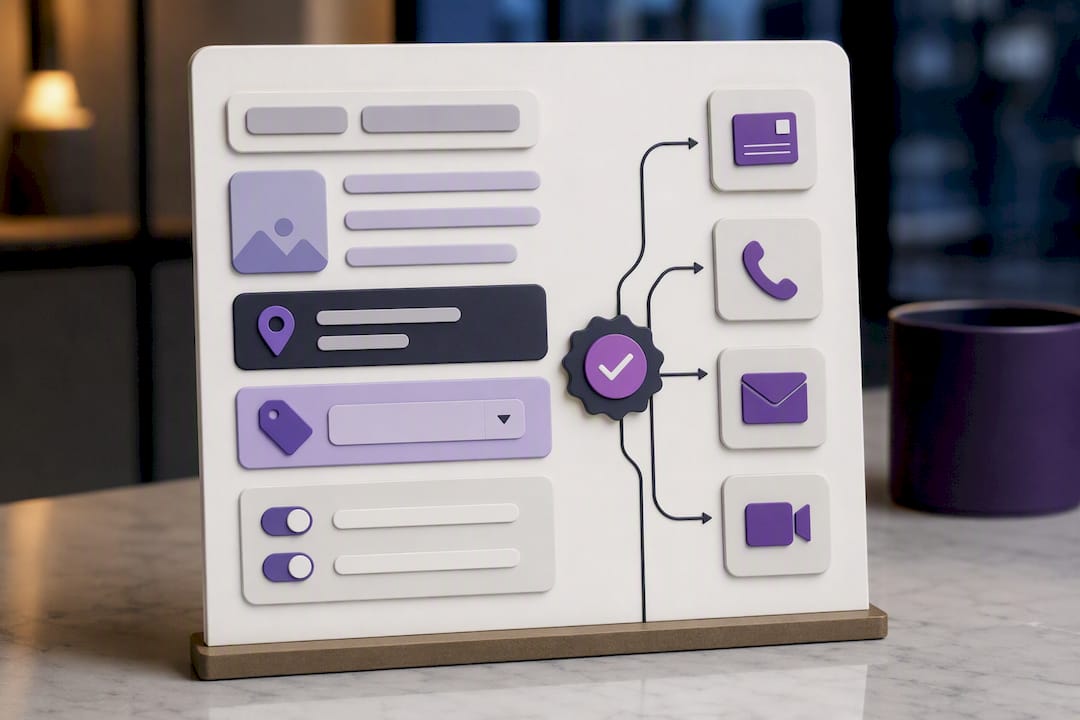
Your Google Business Profile is the foundation, and complete, verified profiles surface more often and drive significantly more visits than incomplete ones. Most businesses treat GBP as a set-it-and-forget-it listing. That’s the mistake.
Run through this audit checklist field by field:
- Business name — use your real, legal operating name. No keyword stuffing like “Joe’s Plumbing Near Me Chicago.”
- Address — exact, matching what’s on your website and other directories, down to suite numbers and abbreviations.
- Hours — including holiday hours, updated before the holiday, not after.
- Primary category — the single most specific option available, not a broad catch-all.
- Secondary categories — additional relevant categories, but only ones that genuinely apply.
- Services and service descriptions — detailed, specific line items rather than one vague paragraph.
- Photos — recent, varied, and geotagged where possible: exterior, interior, team, and work-in-progress shots.
- Attributes — wheelchair accessible, women-owned, outdoor seating, whatever genuinely applies.
- Q&A section — seed it yourself with the questions customers actually ask.
Primary category precision deserves special attention. Relevance, and category accuracy specifically, is usually the most actionable near-me factor and tends to register faster than prominence work. If you’re a “Mexican Restaurant” listed under the generic “Restaurant” category, you’re losing ranking position to competitors who took thirty seconds to fix theirs.
Pro Tip: Search your own primary category in Google Maps and study the top five results. If your services and photos look thinner than theirs, that gap is exactly what you fix this week, not next quarter.
Verify through postcard, phone, email, or video, depending on what Google offers your business type. The moment you’re verified, recheck every field. Verification sometimes resets defaults or strips attributes you’d already set.
Relevance Signals Your Website Needs to Send
Your website should echo what your GBP already says, not contradict it. This is where a lot of local SEO effort gets wasted on generic pages that never mention where the business actually operates.
Choose your page structure based on your business model:
- Dedicated location pages make sense if you have multiple physical storefronts, each with its own address, hours, and staff.
- Service-area pages fit businesses that travel to customers, like plumbers or mobile detailers, where you describe the neighborhoods and cities you cover without claiming a storefront in each.
- City and neighborhood names belong in your copy naturally: “We’ve handled emergency repairs across the Riverside and Linden Hills neighborhoods for six years” reads like a real business. Stuffing “near me” into headers does not.
- LocalBusiness schema should include your name, address, phone number, hours, and geo-coordinates. Service schema should list what you offer, tied to the areas you serve.
- Competitor category checks are worth doing quarterly. Search your top three keywords, note the categories your ranking competitors use, and see if you’re missing an obvious secondary category.
Adding “near you” language can occasionally help organic visibility, but it won’t move the map pack, and forcing the phrase repeatedly into your copy reads poorly to actual visitors. Write for the neighborhood, not the algorithm.
Building Prominence Through Reviews, Citations, and Links
Prominence is the slow-building signal, and it’s the one most businesses neglect because it doesn’t have a single obvious checkbox. It’s built from reviews, citation consistency, photo activity, and links back to your site from other local sources.
Here’s how to build it systematically:
- Set up a review request template that goes out within 24 to 48 hours of service completion, while the experience is still fresh.
- Ask for specifics, not just stars. A review that mentions “fixed our water heater in Maplewood the same day” carries more weight for relevance than a bare five-star rating.
- Audit your citations across major directories using a consistency check, then correct any mismatched name, address, or phone number you find.
- Rotate your photo uploads monthly instead of dumping twenty photos once and forgetting about it. Recent activity signals a business that’s actually open and operating.
- Pursue local links deliberately. Sponsor a neighborhood event, get listed in a local chamber of commerce directory, or contribute a quote to a community news story.
Pro Tip: Ask happy customers to mention their neighborhood in the review itself. “Great experience, Highland Park” does more for local relevance than “Great experience” alone.
A practical audit sequence that produces fast, testable results runs: verify and fix category, align on-page content, clean citations, launch a review campaign, then set a gridded rank baseline. That order isn’t arbitrary. Each step reinforces the next.
Technical Signals That Reinforce Local Visibility
Most “near me” searches happen on a phone while someone is standing on a sidewalk deciding where to go next. If your site loads slowly or the phone number isn’t tappable, you lose that visitor before they finish reading.
Focus your technical audit on these areas:
- Mobile Core Web Vitals — a slow-loading page directly hurts conversion on mobile-heavy near-me traffic, even when your ranking is solid.
- LocalBusiness schema properties — name, address, phone, hours, and geo-coordinates should live in your site’s header or footer template so every page carries them consistently.
- One canonical contact page — with NAP details that exactly match your GBP listing, word for word.
- Click-to-call buttons — placed above the fold on mobile, not buried at the bottom of the page.
- FAQ schema — answering common questions like “Do you offer same-day service?” directly in markup, which can also earn snippet placement.
None of this replaces GBP work. It backs it up, so the signals you’re sending Google line up everywhere a crawler or a customer might look.
Measuring Your Progress With Grid-Based Rank Tracking
A single rank check from your office address tells you almost nothing useful. You might rank first for your own neighborhood and drop out of the top 20 four miles away, and you’d never know it from one search.
Gridded tracking solves this by checking your ranking at dozens of points across your service area simultaneously, not just one. That reveals exactly where your coverage is strong and where it collapses.
Structure your measurement like a real experiment:
- Set a baseline before making changes: run a grid scan and record your average position and map-pack coverage percentage.
- Make one category of change at a time where possible, such as fixing your primary category, so you can attribute movement.
- Rescan on a fixed interval, weekly or biweekly, rather than sporadically whenever you remember.
- Track review velocity alongside rank position to see whether new reviews correlate with coverage gains.
- Watch direction requests and call clicks in your GBP insights as a secondary confirmation that visibility gains are converting.
Statistic Callout: Active management of GBP fields like photos, attributes, and hours correlates with increased visibility in mobile near-me searches, since most of these searches are action-oriented, ending in a call or a set of driving directions.
Agencies managing this for multiple clients benefit most from neighborhood-level scan grids that turn raw position data into a report a client can actually understand at a glance.
The Proximity Paradox: When Optimization Hits a Wall
Distance still wins more often than any SEO tactic. Google’s ranking model treats proximity as the least controllable of the three main factors, which is why a mediocre business three blocks away can outrank a stronger one across town.
But practitioners describe a “rubber-band” effect: strong relevance or prominence can stretch your effective ranking radius for specialized, less common queries where fewer competitors exist. A rare-breed veterinarian or a specialty bakery reaches further than a generic version of the same business.
If you’re a service-area business without a storefront, know the tradeoff: hiding your address correlates negatively with Local Pack rankings across a large multi-city sample. When distance genuinely can’t be fixed, paid local ads or a second physical location often outperform continued organic effort.
Your 90-Day Local SEO Timeline
Assign owners to each phase so nothing stalls waiting on “someone” to handle it.
- Week 1 — Marketing owner verifies GBP, fixes NAP, corrects primary category, uploads current photos.
- Month 1 — Ops team launches review requests; dev team fixes citation mismatches and adds schema.
- Quarter 1 — Whoever owns outreach pursues local links and PR; review flow continues on autopilot.
| Checkpoint | What to measure | Success signal |
|---|---|---|
| Week 1 | GBP completeness, category accuracy | Profile fully verified, correct category live |
| Month 1 | Review velocity, citation consistency | Steady new reviews weekly, NAP matches everywhere |
| Quarter 1 | Grid coverage, map-pack entries | Broader neighborhood coverage than baseline scan |
Escalate speed issues to dev, review disputes to ops, and coverage gaps in unfamiliar neighborhoods to whoever handles local PR.
What Most Local SEO Audits Get Wrong First
Every audit I’ve seen starts the same way: the primary category is wrong, or the NAP on the website doesn’t match the GBP listing. Both errors are invisible to the business owner and glaring to anyone who checks.
The fixes that show up fastest, usually within weeks, are the boring ones: correcting the category, filling out every GBP field, adding real service descriptions. The mistake most businesses make afterward is treating reviews like a light switch, one aggressive push, then silence for six months. Sustained review flow beats a spike every time, because prominence rewards consistency over volume.
— Local
Maprank Turns GBP Fixes Into Proof You Can Show Clients
Fixing a category or launching a review campaign feels productive, but clients want to see it working across their whole service area, not just from one search at the office. Maprank is built for exactly that gap: customizable scan grids that check ranking across dozens of points in a neighborhood, without needing a Google account integration to get started.
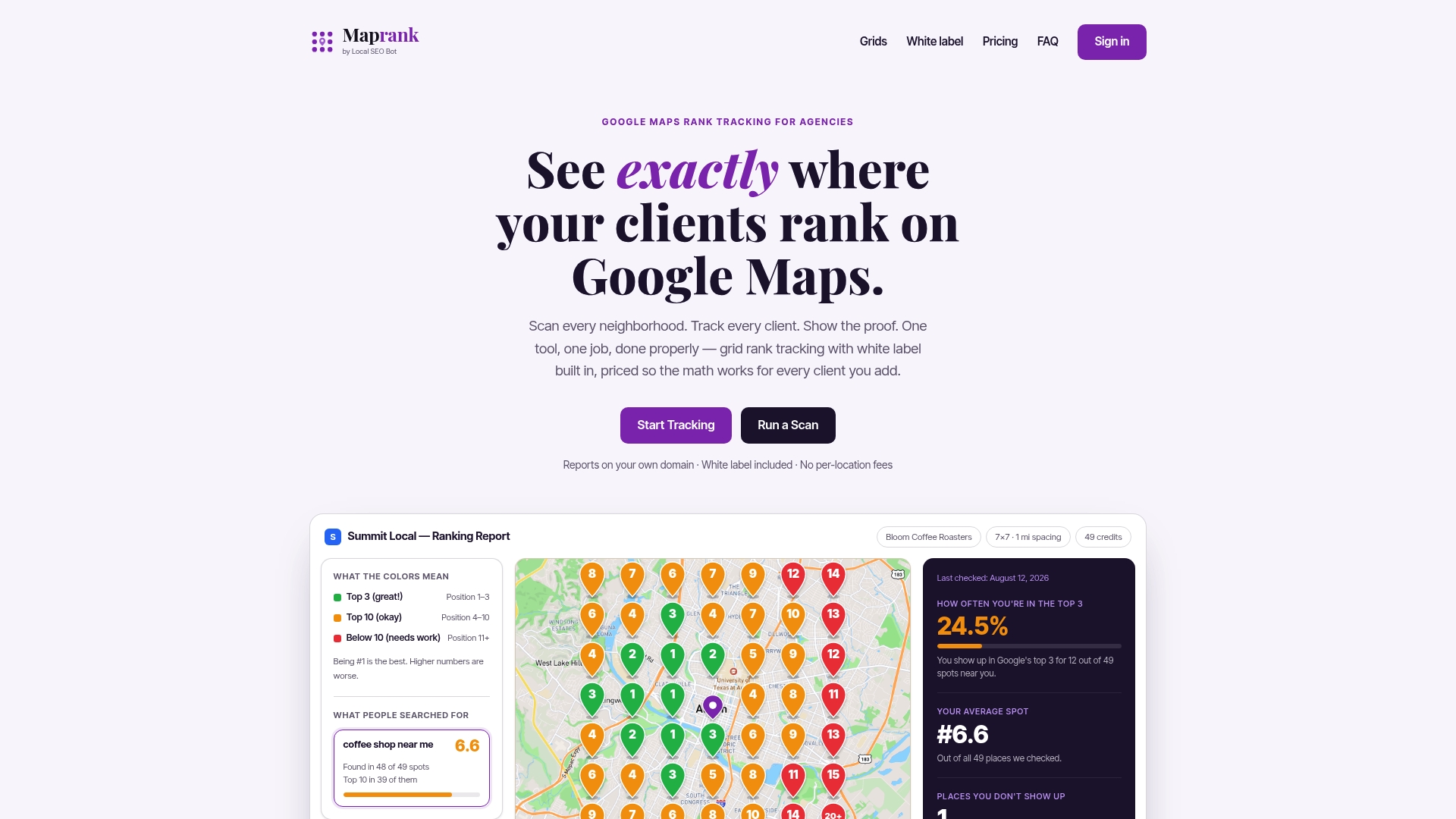
White-label reporting allows agencies to provide clients with branded reports showing where coverage improved after a category fix or a review push, instead of relying on spreadsheets. Pricing uses scan credits rather than per-location fees, and plans support tracking multiple businesses. If you’re managing local SEO for even a handful of clients, check the local rank tracker built for agency reporting and see what a real neighborhood-level baseline looks like for your next client review.
Sources
- How To Rank in Google ’Near Me’ Search Results (2026) - Shopify
- We Analyzed 8,186 Businesses in 200 Cities. Here’s What Actually Gets You Ranking for “Near Me” in 2025 - Sterling Sky
- Proximity, Relevance, and Prominence in Local SEO - Chris W. Brannan
- Near-Me Search Optimization - Search Engine Land
FAQ
How Do I Rank for Near Me Keywords?
Fix your Google Business Profile completeness and primary category first, since those move fastest, then build steady reviews and citation consistency. “Near me” functions as an intent signal Google matches to your business data, not a phrase you need to stuff into your content.
How Do You Find Out What Rank You Are?
A single manual search only shows your rank from one point, which misses how you perform across your whole service area. Grid-based tools like Maprank’s rank checker scan dozens of points across your neighborhood to show real coverage instead of one lucky or unlucky search result.
How Do I Rank Locally on Google?
Prioritize the three factors Google weighs: relevance, distance, and prominence. You can’t change distance, but correcting your primary category, completing your GBP, and building consistent reviews directly improve the two factors you control.
How Do I Check My Rank on Google Maps?
Search your target keyword from different locations across your service area, or use a grid-tracking tool that automates the process across multiple points at once. Checking from a single device in one location gives you an incomplete, often misleading picture of your actual visibility.
Does Google Business Profile Verification Affect Ranking?
Yes. Verified, complete profiles surface more often and generate significantly more visits than unverified or incomplete ones, and verification is a prerequisite for most GBP features that support ranking, including services and posts.