Agencies: Rank Tracking Frequency, Monthly & Weekly Checks (Maprank)
Agencies: Rank Tracking Frequency, Monthly & Weekly Checks (Maprank)
Run monthly grid scans as your baseline for every retained client, full stop. Bump that to weekly the moment you’re actively optimizing a listing or a client starts asking pointed questions about movement. Daily scanning almost never earns its cost. Save it for short diagnostic windows, like confirming a fix landed after a Google Business Profile edit or checking on damage after a review bomb.
TL;DR:
- Weekly scans are necessary during active optimization phases, especially immediately before and after Google Business Profile edits.
- Daily scans should be limited to short periods focused on specific issues like ranking drops or review spikes to avoid unnecessary costs.
- Consistent scan timing during business hours and logging timestamps improve data reliability for month-over-month trend analysis.
- On-demand scans are justified for sudden changes, such as profile updates or negative press, to capture real-time data before noise accumulates.
- Clients’ reporting schedules must align with scan frequency to provide clear, actionable insights without confusion or unnecessary alarm.
Table of Contents
- Setting Rank Tracking Frequency by Client Type and Campaign Stage
- How Do You Decide Frequency for a Specific Client?
- Why Scan Timing and Consistency Control Data Quality
- When Should You Run an On-Demand Scan?
- Matching Report Cadence to Scan Frequency
- How Agencies Actually Run This Day to Day
- Sources
Setting Rank Tracking Frequency by Client Type and Campaign Stage
Not every client needs the same scan cadence, and treating them identically wastes either your scan credits or your team’s attention. The right frequency depends on what stage the account is in and how much risk sits on the table.
A client you’ve had for two years with stable rankings doesn’t need the same scrutiny as one you onboarded last month with a broken GBP category. Match the cadence to the actual work being done, not to a fixed schedule you set once and never revisit.
- Maintenance accounts: monthly full-grid scans, sized between 5x5 or 7x7 depending on how far the business’s service area stretches.
- Active optimization: weekly scans on a 7x7 or 9x9 grid, plus a scan immediately before and after any major GBP change to isolate its effect.
- Crisis or diagnosis: short bursts of daily scans, usually on a tighter grid focused just on the affected zip codes or neighborhoods, until the issue resolves.
- Multi-location or enterprise accounts: staggered monthly scans across the full location list, with weekly spot checks reserved for high-priority stores.
That last point matters more than agencies give it credit for. Full multi-location tracking every week across 40 locations burns through credits fast and produces more noise than insight, since weekly checks work best on a shortlist of top-priority keywords or locations, while monthly full grids handle broader coverage.
| Client type | Scan frequency | Grid size | Trigger for extra scans |
|---|---|---|---|
| Maintenance | Monthly | 5x5 or 7x7 | None, unless client flags an issue |
| Active optimization | Weekly | 7x7 or 9x9 | Before/after GBP edits |
| Crisis diagnosis | Daily (short window) | 3x3 or 5x5 | Rank drop, review spike, competitor move |
| Multi-location | Monthly full + weekly priority | Varies by location | New store opening, negative press |
Grid dimensions themselves aren’t arbitrary. Practitioner guidance places most useful grids between 3x3 and 15x15, with point spacing from 0.25 to 1.5 miles apart depending on how tightly packed the competition is in that market. A dense urban service area needs closer point spacing than a rural business drawing customers from three counties.
How Do You Decide Frequency for a Specific Client?
Cadence decisions get inconsistent fast when every account manager makes the call from gut feel. A short checklist fixes that, and it takes less time to run than most people assume.
- Check the scan-credit budget. How many scans does this client’s plan actually support without cutting into other accounts?
- Identify the campaign stage. Is this pure monitoring, active optimization, or a proof-of-change window right after a big deliverable?
- Factor in business type. Service-area businesses with wide radii often need bigger grids and thus fewer scans per credit dollar than a single storefront.
- Weigh seasonality and volatility. A tax preparer in March needs tighter tracking than in August. A landscaper needs it in spring, not January.
- Write the cadence into the client’s SLA or reporting notes. Verbal agreements about scan frequency evaporate the moment a client asks why rankings look “the same as last time.”
Run this in two or three minutes during onboarding or a quarterly review, and you avoid the two most common failure modes: overspending credits on a sleepy maintenance account, or underscanning a client mid-campaign who then asks why you missed a ranking drop.
Pro Tip: Keep a simple tag on each client record (Monitoring / Optimizing / Crisis) and review it monthly. Cadence should move with the tag, not sit fixed for the life of the contract.
Why Scan Timing and Consistency Control Data Quality
Grid scans compare a location’s visibility over time, and that comparison only means something if the conditions around each scan stay consistent. Running a scan at 7 a.m. one month and 9 p.m. the next introduces variables that have nothing to do with actual SEO performance.
- Schedule recurring scans during normal business hours, and keep the same day of week and time each period.
- Skip scan windows during major local holidays or hours when a large share of nearby competitors close, since open/closed status skews map pack results.
- For large grids that take longer to run, plan the window so it doesn’t straddle an opening or closing time midway through.
- Log the scan’s timestamp as metadata so you can filter out anomalous periods later without guessing why a number looks off.
Keeping scan timing consistent is one of the simplest ways to improve signal quality in a time series, and it costs nothing beyond setting a recurring schedule once. Scheduling scans during typical operating hours specifically reduces variance caused by businesses being open or closed, which otherwise muddies month-over-month comparisons in ways that look like real ranking movement but aren’t.
When Should You Run an On-Demand Scan?
Certain events justify breaking your normal cadence and running an immediate scan, regardless of where you are in the monthly or weekly cycle.
- Trigger identification: a GBP edit, a sudden rank drop, a cluster of negative reviews, a competitor’s aggressive move, or news of a Google algorithm update.
- Immediate grid scan: capture current state right away, before more time passes and muddies the before/after comparison.
- Baseline comparison: pull up the last recorded scan and measure exactly what shifted and where.
- Audit recent changes: review GBP edit history and incoming reviews for anything that lines up with the timing of the drop.
- Check citations and local links: rule out an external cause before assuming it’s an algorithm issue.
- Build a prioritized fix list: rank the likely causes by how fast they can be addressed, then confirm with short, timeboxed daily scans only until the fix shows measurable effect.
Running a scan immediately before and after a significant profile change is standard practice for isolating that change’s real impact, separate from the noise of a normal monitoring cycle.
Matching Report Cadence to Scan Frequency
Clients get confused fast when reports arrive on a different schedule than the actual monitoring. Monthly scans should produce monthly reports. Weekly scans during an active campaign should produce weekly summaries, even short ones.
- A heatmap snapshot showing current coverage across the grid.
- The percentage of grid points now in the map pack, and how that’s changed since the last report.
- Keyword-by-keyword shifts, not just an averaged rank number.
- Specific problem zones where visibility is weak or absent.
- A short list of suggested next actions tied to what the scan revealed.
Reports built around heatmap coverage and per-keyword change give clients a clearer picture than a single blended rank score, which tends to hide exactly the neighborhood-level gaps clients care about most.
| Report element | Why it matters |
|---|---|
| Heatmap snapshot | Shows exact coverage gaps by neighborhood |
| % green coverage change | Tracks trend without hiding local variance |
| Keyword-level shifts | Separates real movement from single-term noise |
| Problem zones | Directs where optimization effort goes next |
| Next actions | Keeps the report tied to a plan, not just data |
Set expectations early: day-to-day local rank fluctuations of 2 to 4 positions are normal and not a sign anything’s wrong. A line in your report template like “Rankings typically shift a few positions week to week; we flag changes only once they hold for two consecutive scan cycles” heads off a lot of unnecessary panic calls.
How Agencies Actually Run This Day to Day
Most agencies that get cadence right treat it as a scheduling problem, not a judgment call made fresh every week. Recurring scans go on the calendar once, reports go out on a matching schedule, and on-demand scans happen only when a client makes a GBP change or something looks off in the data.
Predictable, credit-based pricing changes the math here. When scans don’t carry per-location fees, running a slightly more frequent cadence on a volatile client doesn’t blow up the invoice, which is the real reason most agencies underscan the accounts that actually need closer attention. Fixed, transparent pricing paired with unlimited tracked businesses is what actually lets agencies scan more often without billing friction getting in the way of a sound monitoring decision.
Maprank charges by scan credits, not by the number of client locations you track. Every plan includes unlimited businesses and white-label reporting on your own domain, so the report a client opens shows your agency’s branding, not a third-party dashboard they’ve never heard of.
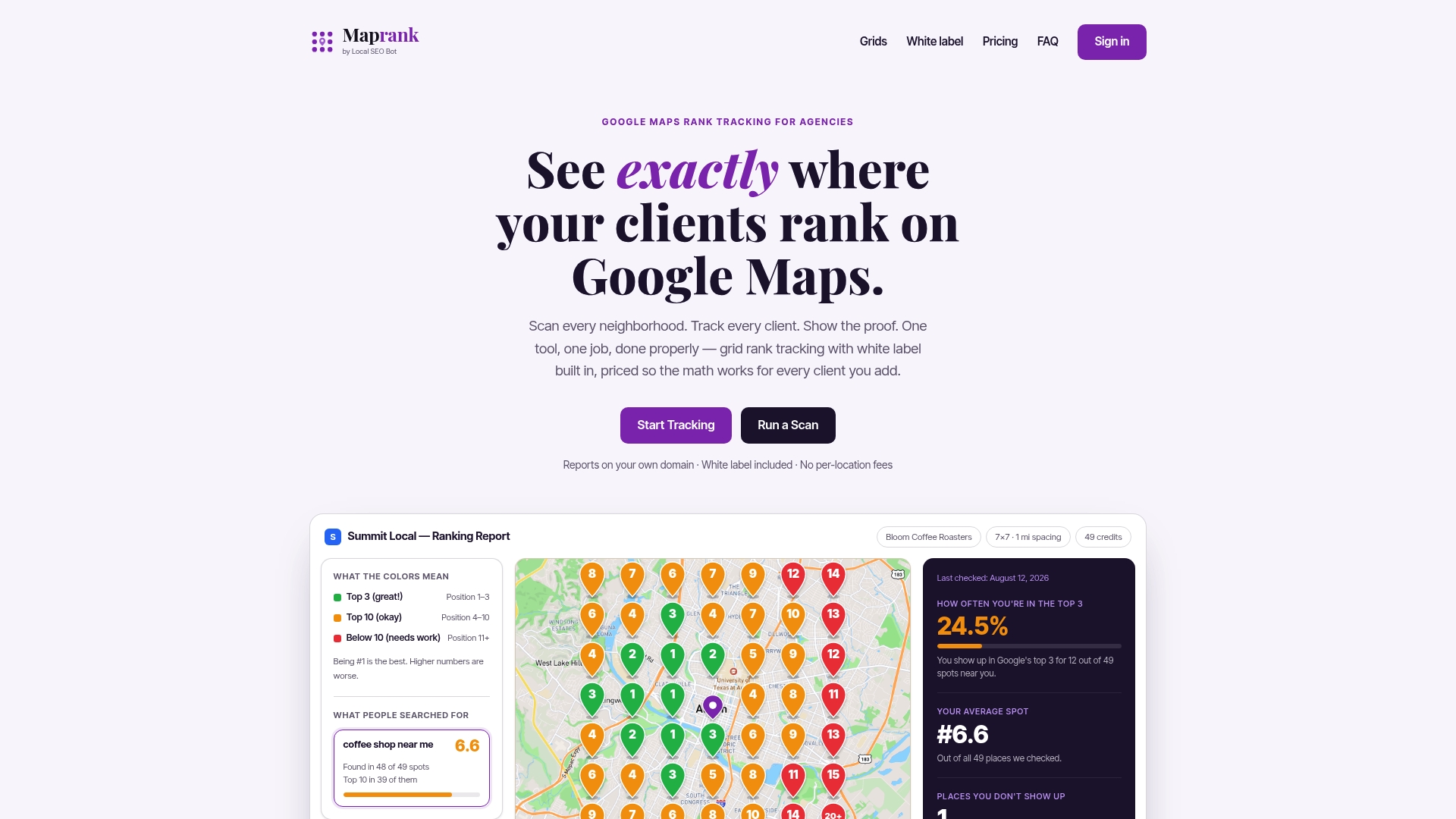
That combination matters most for agencies juggling a mix of maintenance and active-optimization clients, since the customizable scan grid lets you size each grid to the client’s actual service area instead of paying for coverage nobody needs. If you’re managing scans across several storefronts or a wide service radius, the multi-location tracking setup handles staggered monthly scans without manual scheduling for each address.
Set up your first grid-based rank tracker and run a scan on your highest-priority client this week to see how the heatmap compares to whatever single-point checks you’ve been relying on.
Sources
For more technical detail on how scan grids work and how to size them, the Destinali guide covers grid mechanics well. The theStacc glossary entry breaks down grid spacing options in more depth. Agencies weighing ROI reporting alongside rank data may also find offline conversion tracking practices useful context for client reports.
- How to Track Your Google Map Rankings Using a Grid-Based Scan Tool | Destinali
- Free Local Rank Tracker Guide 2026 (Maps & GBP Tracking)
- Geo Grid Rank Tracking: Definition, How It Works & 2026 Guide | theStacc Glossary