Grid Proof: Turn Fresh Reviews Into Map Wins for Agencies
Grid Proof: Turn Fresh Reviews Into Map Wins for Agencies

Review recency matters: recent reviews increase buyer confidence, often lift conversions, and act as a measurable signal for local visibility. Ninety-seven percent of consumers say review timing shapes their purchase decisions at least somewhat, and platform guidance from Google and the FTC both push businesses toward steady, honest review flow rather than one-time pushes. The rest of this guide explains how to measure recency, when it matters most, and how to build a compliant system for keeping feedback current.
TL;DR:
- Regularly collecting recent reviews is crucial for maintaining local search prominence and helps businesses appear more engaged and trustworthy to consumers.
- The impact of review recency is higher in service industries with fluctuating conditions, such as restaurants and salons, and less critical for stable product categories.
- Businesses should ask for reviews with timing aligned to key milestones, delay requests strategically, and avoid incentivizing positive feedback to stay compliant with Google and FTC rules.
- Consistent review flow, rather than total volume, increases consumer trust and supports better map-pack visibility, especially when complemented by active response management.
- Tracking review recency with simple metrics and neighborhood-level tools like Maprank helps optimize local visibility and identify where fresh feedback influences ranking shifts.
Table of Contents
- What Review Recency Actually Means
- Why Recency Shapes Consumer Trust and Buying Decisions
- How Recency Influences Local Search and Map Rankings
- Balancing Recency Against Volume, Quality, and Response Rate
- How to Keep Reviews Fresh Without Breaking the Rules
- What Timing Research Says About Asking for Reviews
- Staying Compliant: Google and FTC Rules for Fresh Reviews
- Tracking Recency: Metrics, Workflows, and Tools
- Operationalizing Recency Across Agency Client Portfolios
- Measure the Neighborhood Effect of Fresh Reviews
- Sources
- FAQ
What Review Recency Actually Means
Review recency refers to how recently a review was posted relative to today, not how recently the reviewer had the experience being described. Those two dates often diverge. A customer might eat at a restaurant on a Friday and post a review the following Tuesday, so the “experience date” and “posting date” sit four days apart. Most platforms display the posting date because that’s the timestamp they can verify, while the experience date lives buried in the review text itself, if it’s mentioned at all.
Google, Yelp, and most e-commerce platforms show reviews in reverse chronological order by default, with relative timestamps like “2 weeks ago” or “posted in March.” Amazon and similar retail sites sometimes flag purchase-verified timing, such as “bought 3 days ago,” which reads as a distinct signal from the review’s own posting date. That distinction between a fresh purchase and a fresh opinion turns out to matter more than most business owners realize, a point covered later in the temporal-marker research.
Recency carries different weight depending on what’s being reviewed. A contractor, a med spa, or a restaurant depends on current conditions: staff turnover, seasonal menus, inventory changes. A five-year-old review of a plumbing company tells you almost nothing about whether that company still shows up on time. Durable goods behave differently. A detailed review of a cast-iron skillet or a mattress from three years ago can still be more useful than a rushed one-liner posted last week, because the product itself hasn’t changed.
Why Recency Shapes Consumer Trust and Buying Decisions
Consumer research settles this question with unusual clarity. A PowerReviews survey of 9,000 shoppers found that 97% consider review recency at least somewhat important when evaluating a product or business. Even more striking: Many consumers prefer to see a smaller number of recent reviews rather than a large volume of older ratings. Given a choice, a significant portion of consumers ideally want reviews from within the past month.
That preference isn’t about volume anxiety. It’s about relevance. Shoppers assume a business’s current state, staffing, inventory, service quality, matches its most recent feedback more closely than its oldest.
Statistic Callout: Nearly two out of three consumers would trade a bigger pile of old reviews for a smaller set of fresh ones. Volume alone no longer wins the trust contest.
Academic work backs this up with more nuance. Research on contextual effects of review recency shows recency signals current condition, and its importance shifts depending on what’s being evaluated. It matters more when quality or availability changes often (a hotel, a hair salon, a food truck) and less when the underlying product attributes stay fixed.
Practical takeaways for businesses managing feedback:
- Prioritize recency hardest for services where quality can shift month to month, not just year to year.
- Don’t panic over a temporary dip in review count. A shopper who sees five reviews from last month often trusts you more than one who sees fifty from two years ago.
- Pair recency with substance. A fresh one-word review carries less weight than an older, detailed one for complex purchases.
How Recency Influences Local Search and Map Rankings
Google’s local ranking system runs on three pillars: relevance, distance, and prominence. Review recency lives inside prominence, the pillar that reflects how well-known and trusted a business is based on information Google can gather across the web, including its review profile.

Google has never published a formal decay curve showing exactly how much weight a review loses per month or year. That’s worth stating plainly because plenty of SEO content implies a precise formula that doesn’t exist in any public documentation. What’s known instead is directional: a business with a steady stream of new reviews signals ongoing activity and customer engagement, which feeds into how prominent Google considers it within a given search or map view.
AI-driven recommendation features, the kind now surfacing inside Search and Maps summaries, lean on review content and timing to describe current service quality. A business with reviews mentioning “great during the holidays” from three years ago and nothing since gives those systems very little to work with about how things stand today. A steady trickle of recent mentions, on the other hand, gives both human readers and automated summarization more current material to draw from.
None of this means recency overrides everything else. A business with thousands of reviews and a strong average rating built over a decade still carries real prominence weight, even if its most recent review is from last month rather than last week. Recency is one input feeding a much larger model, not a switch that resets a business’s standing overnight. Businesses tracking grid-based rank changes alongside review activity tend to notice this pattern: consistent review flow correlates with steadier map-pack presence, even without a documented mechanism explaining exactly why.
Balancing Recency Against Volume, Quality, and Response Rate
Recency doesn’t operate alone. A business with 20 reviews posted in the last two months but a 3.5 average rating faces a different trust problem than one with 400 reviews averaging 4.7 but nothing new since last year. Neither situation is automatically better; they’re different risk profiles.
Reviewer diversity and response rate both change how much recency matters. A cluster of five-star reviews posted within the same week, all short and similarly worded, reads as suspicious no matter how fresh they are. Reviews spread across different customer types, project sizes, or use cases, posted at a natural pace, carry more credibility even at a slower cadence. Businesses that reply to reviews, especially recent ones, reinforce that the account is actively managed, which amplifies the trust benefit of any single fresh review.
Quick prioritization rules by business type:
- Restaurants, salons, and hospitality: weight recency heavily; aim for reviews touching every month, not just seasonally.
- Home services and contractors: recency plus response rate matters more than raw volume, since trust hinges on reliability now.
- Retailers selling durable goods: older detailed reviews still pull weight; don’t sacrifice review depth chasing freshness alone.
- Professional services (legal, medical, financial): steady, spaced-out recency beats bursts, since burst patterns invite skepticism.
How to Keep Reviews Fresh Without Breaking the Rules
Building lasting review freshness means running a continuous collection system, not a single campaign that fades after a launch push. Here’s a practical sequence:
- Set collection triggers tied to real milestones. Post-delivery for products, a few days after service completion for contractors, or after a support ticket resolves, are all natural moments to ask.
- Use low-friction channels. A direct review link in a post-service email, an in-app prompt after a completed order, or a QR code printed on a receipt each remove steps between the customer and the review form.
- Space requests to match your sales cycle. A weekly service business might ask every visit; a business with infrequent large purchases might ask quarterly rather than after every transaction.
- Monitor cadence, not just count. Track whether reviews are arriving at a steady rate or clustering unnaturally, which can trigger platform scrutiny.
- Avoid gating and selective solicitation. Never filter customers by predicted sentiment before asking, and never offer incentives conditioned on a positive rating. The FTC’s 2024 rule bans exactly this practice, along with fake reviews and undisclosed insider reviews.
A simple ask template that stays compliant: “We’d love your honest feedback on your recent experience, good or bad. It helps other customers and helps us improve.” Nothing there conditions the ask on a specific outcome.
Pro Tip: Send the request from a real name tied to the business, not a generic “no reply” address. Response rates climb when customers feel like they’re replying to a person, not a system, and that authenticity often shows up in review depth too.
What Timing Research Says About Asking for Reviews
The timing of the ask matters as much as the ask itself. Field experiments described by Baylor’s Keller Center found that delayed reminders often increase the likelihood a customer posts a review, while immediate reminders sent right after a purchase or service can actually reduce posting rates in experience-based categories. The theory: customers need time to form a settled opinion, and an ask that lands before that happens feels premature and gets ignored or declined.

Statistic Callout: In the experiments Jung and colleagues ran, later-timed reminders outperformed immediate ones for review posting rates, an effect strong enough that the researchers recommend businesses test delay windows by category rather than defaulting to “ask immediately.”
A separate line of research on temporal markers adds a twist. Studies on how timestamps influence review persuasiveness found that reviews flagged with very proximate timestamps, like “bought one day ago,” can actually read as less persuasive. Readers infer the reviewer hasn’t used the product long enough to know if it holds up, which undercuts perceived expertise even though the review is objectively “fresh.”
Practical takeaways by category:
- Experience-based purchases (restaurants, travel, services): wait a few days to a week before asking, giving the customer time to reflect.
- Durable goods with a learning curve (electronics, appliances, tools): delay the ask two to four weeks so the reviewer has real usage to describe.
- Simple, low-consideration purchases: a shorter delay works fine, since there’s little to learn about the product over time.
Staying Compliant: Google and FTC Rules for Fresh Reviews
Google Business Profile guidance is direct: reviews must reflect genuine experiences, businesses can’t gate reviews by pre-screening customers for sentiment, and replying to reviews is encouraged as a best practice rather than optional. Google recommends sharing a direct review link or QR code rather than funneling only satisfied customers toward the request.
The FTC’s 2024 rule adds federal teeth to similar principles: it prohibits fake reviews, bans incentives conditioned on a review’s sentiment, requires disclosure of insider reviews (employees, close relatives), and forbids suppressing negative reviews through legal threats or contract clauses.
A short compliance checklist:
- Ask every customer, not just the ones you expect to leave five stars.
- Never offer a discount, refund, or gift contingent on a positive review.
- Disclose any review written by an employee or someone with a financial stake in the business.
- Respond to negative reviews instead of trying to remove or bury them.
- Keep review requests generic in wording. “Tell us about your experience” beats “leave us five stars.”
Tracking Recency: Metrics, Workflows, and Tools
Measuring recency starts with a small set of metrics tracked on a rolling basis rather than a single snapshot. The most useful ones: count of reviews in the last 30, 90, and 180 days; average review age across your full profile; review velocity (new reviews per week or month); and a rolling recency rate, the percentage of your total reviews posted within the last quarter.
A basic workflow looks like this: establish a baseline for each metric today, then track changes weekly or monthly. Businesses running multiple locations or competing in dense markets often layer in a second data point, correlating review velocity against local ranking movement using a neighborhood-level rank tracker to see whether fresher review activity lines up with map-pack gains in specific grid points.
- Review-monitoring tools aggregate new reviews across platforms and alert you to velocity drops.
- Analytics dashboards connect review timing to conversion or foot-traffic data over the same window.
- Grid-based Maps rank trackers let you check whether ranking shifts in specific neighborhoods coincide with review activity, rather than guessing from a single average position.
Even a basic spreadsheet works to start: one column for review date, one for rating, one for the neighborhood or location tag if you manage several. The goal isn’t sophistication, it’s consistency in checking the same numbers on the same schedule.
Operationalizing Recency Across Agency Client Portfolios
Working across dozens of local business profiles surfaces the same pattern repeatedly: clients who maintain a steady drip of new reviews tend to hold map-pack positions more consistently than clients with review counts that spike and then go quiet for months. The correlation isn’t a guarantee, but it shows up often enough to treat review cadence as a real operational lever, not an afterthought.
Agencies that track review timing alongside neighborhood-level rank data, rather than a single average position, get a clearer read on whether a client’s local visibility is actually improving or just holding steady on old momentum.
— Local
Measure the Neighborhood Effect of Fresh Reviews
Fresh reviews are only half the story if you can’t see how they move the needle in specific neighborhoods, not just your average city-wide position. Maprank was built for exactly that gap: grid-based Google Maps rank tracking that shows agencies precisely where a client stands block by block, without requiring a Google account integration for every location.
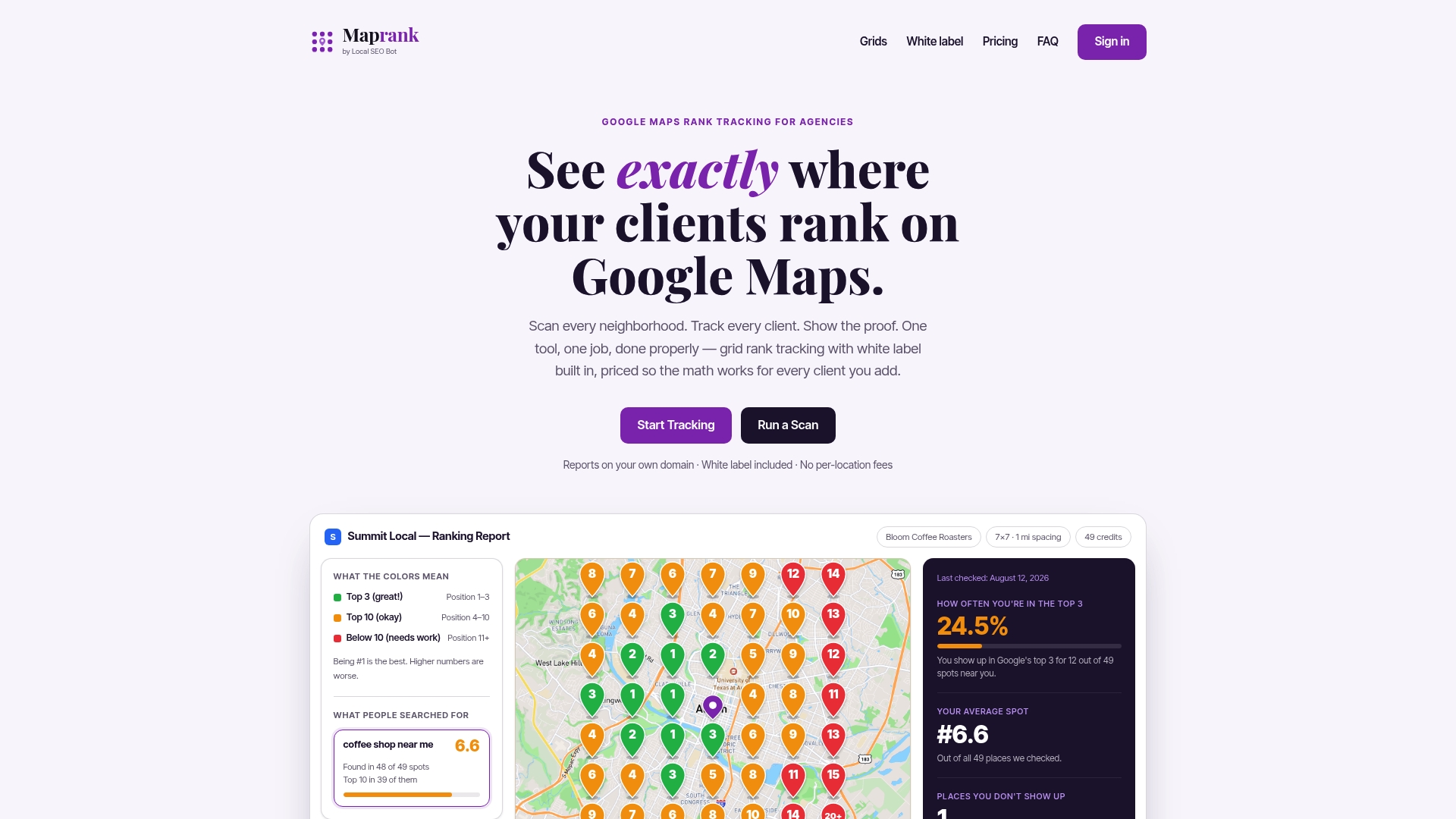
Because Maprank’s scan grids are fully customizable, you can set up a tracking pattern around a specific business and watch whether a burst of new reviews lines up with movement in the surrounding grid points, then hand a client a white-labeled report showing exactly that. Pricing runs on straightforward credit bundles, from Maprank Solo at $19 a month up to Maprank Scale, with unlimited businesses included on every tier rather than per-location fees stacking up. If you want to see how a specific listing’s neighborhood coverage looks right now, run a one-off rank check and get a direct read on where the gaps are.
Sources
- The Power of Review Volume & Recency
- Contextual effects of online review recency
- Wait just a minute: When to ask for online reviews
- FTC announces final rule banning fake reviews
FAQ
What does “recency” mean in marketing?
In marketing, recency refers to how recently an action, purchase, or piece of feedback occurred relative to today. For reviews specifically, it measures the gap between the posting date and the present, which shoppers use as a proxy for how current a business’s quality or condition is.
How long does the review process take from ask to post?
There’s no fixed timeline, but field experiments suggest delayed reminders, sent days rather than minutes after a purchase, tend to produce higher posting rates. Most customers who do leave a review post it within one to two weeks of being asked, though experience-based purchases sometimes take longer as opinions settle.
Can you give an example of how recency affects a review’s impact?
A five-star review of a restaurant posted last week signals that the current kitchen staff and menu are performing well right now. The same five-star review from two years ago says nothing about tonight’s service, especially if the chef or ownership has changed since then.
What percentage of people actually leave reviews?
Exact participation rates vary widely by industry and aren’t part of a single standardized figure, but consumer research consistently shows that most buyers read reviews far more often than they write them. What’s better documented is preference: 97% of consumers say recency matters when they do read reviews, which is why maintaining a steady flow matters more than chasing a high total count.
Does Maprank track review recency directly?
Maprank focuses on grid-based Google Maps rank tracking rather than review monitoring itself, but agencies use it alongside review activity to see whether fresh reviews correlate with rank changes in specific neighborhoods. Current plans and pricing are listed on the Maprank site.